
I. Introduction
In this paper, we examine how trade wars reshape energy markets and the direction of decarbonization. Our central hypothesis is that trade conflict does not have a uniform effect on the energy transition. Instead, its effect depends on the relative exposure of the energy system to two distinct sources of vulnerability: fossil-fuel dependence and clean-input dependence. More precisely, trade-war intensification accelerates decarbonization only when the cost pressure on fossil energy rises more than the cost pressure on clean-energy inputs; otherwise, it induces what we call dirty relocalization, namely a shift toward politically secure fossil energy when clean technologies are constrained by disruptions to mineral and component supply chains. This proposed relationship is motivated by the broader literatures on weaponized interdependence and energy security, both of which suggest that international dependence can generate efficiency in normal times but become a source of fragility under geopolitical stress (Farrell & Newman, 2019; Goldthau & Sitter, 2015; LaBelle, 2024).
This hypothesis matters because current debates often assume that trade wars either weaken the transition by raising costs or strengthen it by making imported fossil fuels less attractive. That dichotomy is too simple. The contemporary energy system is dual in structure. On the one hand, many economies remain exposed to imports of oil, gas, coal, or refined fossil products. On the other hand, the clean-energy transition relies heavily on trade-intensive supply chains for lithium, cobalt, nickel, graphite, copper, rare earths, batteries, solar components, and power electronics. As a result, the same geopolitical shock can simultaneously penalize fossil imports and the upstream inputs required for low-carbon deployment. Whether trade fragmentation ultimately accelerates or delays decarbonization is therefore an open theoretical question rather than a foregone conclusion (Farag & Zaki, 2025; International Energy Agency, 2025).
To address this issue, we develop a Geoeconomic Energy-Wedge framework in which energy services are produced from fossil energy and a clean-energy composite. The framework distinguishes between a fossil wedge, which captures the increase in fossil-energy costs generated by tariffs, sanctions, import concentration, and policy uncertainty, and a clean-input wedge, which captures the increase in clean-energy costs generated by trade barriers and bottlenecks affecting critical minerals and refined intermediates. The paper then derives a threshold condition that links these two wedges and shows how their relative magnitudes determine the direction of substitution between fossil and clean energy. To make the intuition transparent, we also provide a compact numerical illustration of the parameter regions in which trade conflict accelerates the transition and those in which it instead produces dirty relocalization. In addition, we extend the framework dynamically by allowing for irreversible clean investment under uncertainty.
The main findings are straightforward. First, trade wars accelerate decarbonization only when fossil vulnerability exceeds clean-input vulnerability. Second, import concentration matters independently of tariff rates because concentrated supply chains amplify the transmission of geopolitical shocks into energy costs. Third, policy uncertainty raises the threshold for clean-capacity investment, implying that even when expected fossil costs rise, the transition may still be delayed if investors face unstable trade rules and uncertain future access to critical inputs. These results provide a coherent explanation for why trade wars can raise energy prices, reduce welfare, and generate markedly different transition outcomes across countries and sectors.
These findings make two contributions to the literature. The first is conceptual. The paper brings together research on trade wars, energy security, and decarbonization within a single framework that explicitly distinguishes between fossil vulnerability and clean-supply-chain vulnerability. This helps clarify why geoeconomic fragmentation should not be treated as either automatically green or automatically brown. The second contribution is policy-relevant. The framework shows that broad protectionism is not, in itself, an energy-security strategy. What matters is whether policy reduces the clean-input wedge relative to the fossil wedge. This finding directs attention to targeted resilience measures, such as diversifying critical-mineral sourcing, strengthening domestic refining and recycling capacity, and enhancing policy credibility for low-carbon investors.
The remainder of the paper is organized as follows. Section II presents the Geoeconomic Energy-Wedge framework. Section III derives the main threshold result, examines its implications for emissions, and develops the dynamic investment extension. Section IV concludes by discussing the policy implications and outlining directions for future empirical implementation.
II. The Geoeconomic Energy-Wedge Framework
Consider a representative home economy in which a firm supplies a given amount of energy services, by combining two distinct energy inputs: fossil-fuel energy, and a clean-energy composite, Here, denotes conventional fossil-based energy use, while denotes a low-carbon energy composite whose cost depends on domestic capital and imported critical-mineral inputs, as specified below. At the upper tier, the model uses a CES aggregator to describe substitution between and At the lower tier, is represented as a Cobb–Douglas composite of domestic capital, and an imported mineral/intermediate input, The main threshold condition does not rely on the Cobb–Douglas lower tier itself. It requires only that the unit cost of the clean composite increase with mineral-input exposure, so the qualitative result holds under a more general lower-tier cost function. Energy services are produced using a CES aggregator:
\[S = \left\lbrack \alpha F^{\frac{\sigma - 1}{\sigma}} + (1 - \alpha)C^{\frac{\sigma - 1}{\sigma}} \right\rbrack^{\frac{\sigma}{\sigma - 1}}\tag{1}\]
with and The CES form is well defined for any positive other than unity; the case is obtained by continuity and yields the Cobb–Douglas limit.
This nested specification separates two distinct margins: substitution between fossil and clean energy at the top level, and input assembly within clean energy at the lower level. Given the input prices and the firm chooses and to minimize total energy expenditure:
\[\min\mspace{6mu} P_{F}F + P_{C}C\tag{2}\]
subject to the requirement that it delivers the required level of This problem yields the standard dual price index and relative-demand condition reported below. The decomposition of into domestic capital and imported mineral inputs is then introduced in the next step of the model.
By standard CES duality, the energy-service price index is:
\[P_{S} = \left\lbrack \alpha P_{F}^{1 - \sigma} + (1 - \alpha)P_{C}^{1 - \sigma} \right\rbrack^{\frac{1}{1 - \sigma}}\tag{3}\]
and the relative demand is:
\[\frac{C}{F} = \left( \frac{1 - \alpha}{\alpha} \right)^{\sigma}\left( \frac{P_{F}}{P_{C}} \right)^{\sigma}\tag{4}\]
Equation (4) clarifies the core mechanism: the direction of substitution depends on the relative movement of fossil and clean costs.
Let trade-war intensity be denoted by Fossil energy is imported at the following price:
\[P_{F} = {\bar{P}}_{F}\exp\left\lbrack \left( \tau_{F} + \chi_{F}h_{F} + \psi_{F}u \right)\theta \right\rbrack\tag{5}\]
where captures direct tariff and sanction exposure; is the concentration of fossil import sources; is policy uncertainty; and are sensitivity parameters. A higher means that a given geopolitical shock has larger pricing power because fewer alternatives exist.
At the lower tier, the clean composite is the clean-energy composite is produced as:
\[C = AK^{\beta}M^{1 - \beta}\tag{6}\]
with This lower-tier specification is used only to map the cost of clean energy into domestic capital and imported mineral components. The study’s main threshold result does not require a specific correspondence between the CES and Cobb–Douglas functional forms. It requires only that the unit cost of the clean composite increase as exposure to critical-mineral bottlenecks increases. The corresponding unit cost is given by:
\[P_{C} = BA^{- 1}w_{K}^{\beta}P_{M}^{1 - \beta}\tag{7}\]
where is the domestic capital cost and is a positive constant. The imported mineral and intermediate input is priced as:
\[P_{M} = {\bar{P}}_{M}\exp\left\lbrack \left( \tau_{M} + \chi_{M}h_{M} + \psi_{M}u - s \right)\theta \right\rbrack\tag{8}\]
Here, captures tariffs and export-control exposure affecting critical minerals and clean intermediates; is the concentration of those supply chains; captures uncertainty effects; and is a resilience parameter summarizing domestic refining, recycling, substitution capacity, and targeted industrial support that partially offsets vulnerability. Combining Equations (7) and (8) will result into the following:
\[\small \ln P_{C} = \text{constant} + (1 - \beta)\left( \tau_{M} + \chi_{M}h_{M} + \psi_{M}u - s \right)\theta\tag{9}\]
Define the two geoeconomic wedges:
\[\Lambda_{F} = \tau_{F} + \chi_{F}h_{F} + \psi_{F}u\tag{10}\]
\[\Lambda_{C} = (1 - \beta)\left( \tau_{M} + \chi_{M}h_{M} + \psi_{M}u - s \right)\tag{11}\]
Equations (10) and (11) summarize how strongly trade-war intensity translates into increases in fossil and clean energy costs. This framework rests on a small set of maintained assumptions. First, the analysis is conducted in partial equilibrium and considers a representative home economy with a price-taking firm that chooses between fossil and clean energy to minimize expenditure for a given level of energy services. Second, substitution between fossil and clean energy is governed by a CES upper-tier aggregator, while the clean-energy block is represented at the lower tier by domestic capital and imported mineral inputs; the lower-tier form is adopted for tractability and transparent cost mapping. Third, trade-war intensity, import-source concentration, policy uncertainty, and resilience policy are treated as exogenous determinants of relative input costs in the short run. Fourth, baseline emissions are assumed to arise only from fossil energy, so the model isolates the composition effect of trade conflict on decarbonization. Finally, the dynamic extension uses a reduced-form specification and assumes irreversible clean investment under uncertainty. These assumptions define the scope of the model and the interpretation of the threshold results.
The qualitative threshold logic requires only that trade conflict raise fossil and clean-input costs through their respective wedges; it does not depend on a particular lower-tier functional form.
III. Main Results
Differentiating Equation (4) with respect to yields:
\[\frac{d\ln(C/F)}{d\theta} = \sigma\left( \Lambda_{F} - \Lambda_{C} \right)\tag{12}\]
Proposition 1. Trade-war intensification increases the clean-to-fossil energy ratio if and only if:
\[\Lambda_{F} > \Lambda_{C}\tag{13}\]
Proof. This follows immediately from Equation (12). If the fossil wedge exceeds the clean wedge, the relative price of fossil energy rises faster, prompting firms to substitute toward clean energy. If the inequality is reversed, firms substitute away from clean energy.
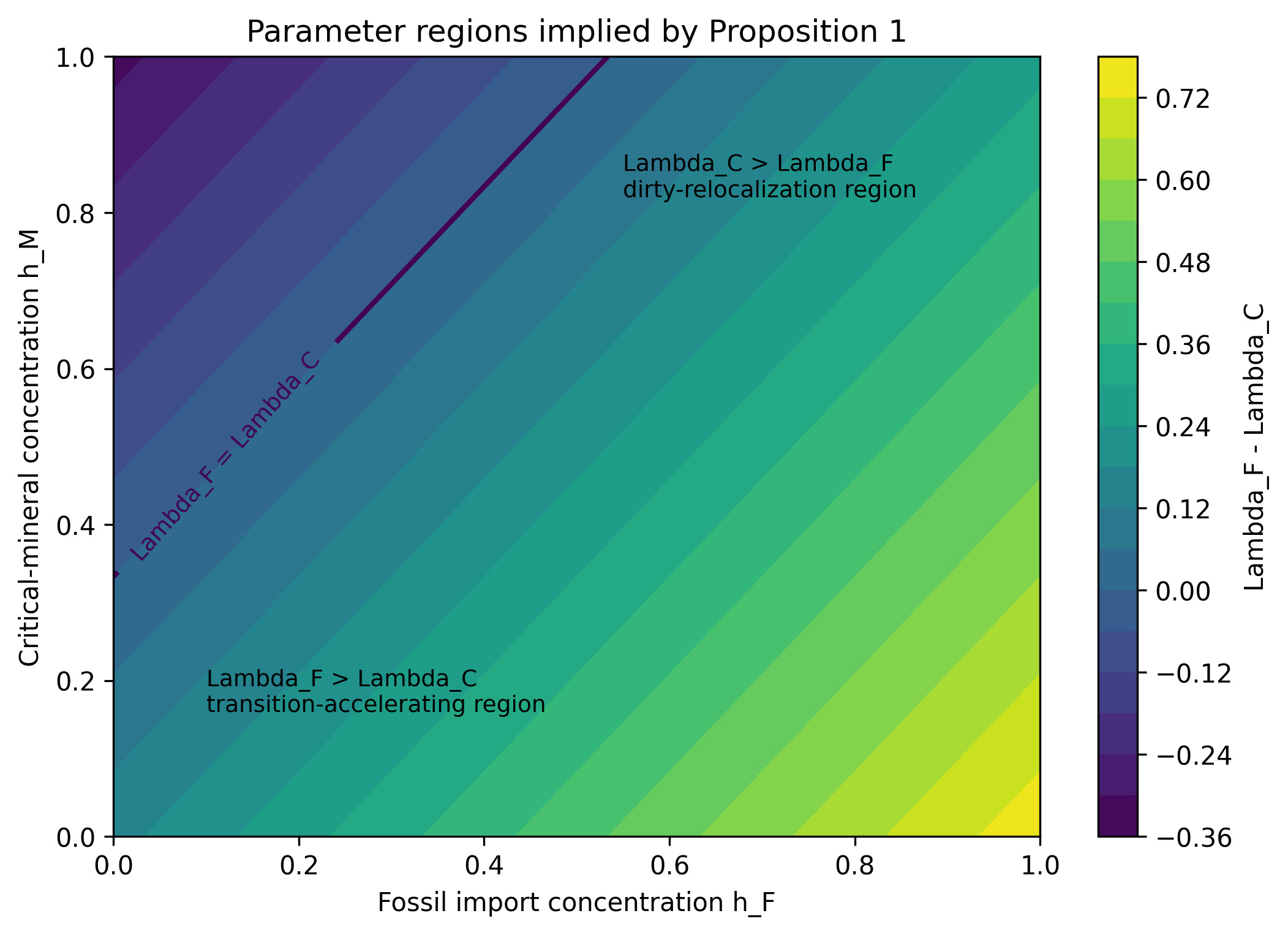
A simple numerical illustration makes the threshold in Proposition 1 transparent. Using a baseline calibration with and the wedges simplify to:
\[\Lambda_{F} = 0.40 + 0.60h_{F}\]
\[\Lambda_{C} = 0.24 + 0.48h_{M}\]
Figure 1 plots the threshold locus in the plane. Below the line, the fossil wedge exceeds the clean wedge, so trade-war intensification raises the clean-to-fossil energy ratio, accelerating the transition. Above the line, the clean-input wedge is larger, so fragmentation pushes the economy into the dirty-relocalization regime. The figure shows that the sign of the transition effect is determined not by trade conflict alone, but by the relative concentration of dependence on fossil fuels and critical minerals.
Proposition 1 is the paper’s threshold theorem. It shows that trade wars are not inherently “green” or “brown.” The sign depends on relative exposure. The result also yields two immediate comparative statics:
\[\frac{\partial\left\lbrack d\ln(C/F)/d\theta \right\rbrack}{\partial h_{F}} = \sigma\chi_{F} > 0\tag{14}\]
\[\frac{\partial\left\lbrack d\ln(C/F)/d\theta \right\rbrack}{\partial h_{M}} = - \sigma(1 - \beta)\chi_{M} < 0\tag{15}\]
Thus, fossil-source concentration tends to make trade conflict more conducive to the energy transition, while critical-mineral concentration tends to make it more likely to delay the transition. This asymmetry is central to the energy problem. A system can be vulnerable to fossil imports while simultaneously remaining vulnerable to clean-technology inputs. Only the relative magnitudes of these vulnerabilities determine the direction of adjustment.
We refer to the region as the dirty-relocalization regime. In this regime, firms respond to trade fragmentation by relying more heavily on politically secure fossil energy, not because fossil energy is technologically efficient, but because mineral and component bottlenecks constrain the clean transition. This possibility is consistent with recent research emphasizing the connections among fossil lock-in, resource dependence, and energy-transition policy, particularly in economies where structural dependence constrains the available paths of adjustment (Bigerna et al., 2026). To link energy substitution to aggregate emissions, let downstream demand for energy services be isoelastic:
\[S = DP_{S}^{- \eta}\tag{16}\]
with Emissions are generated only by fossil energy:
\[X = \varepsilon F\tag{17}\]
Using the CES demand, fossil demand satisfies:
\[\ln F = \text{constant} + lnS - \sigma\left( \ln P_{F} - lnP_{S} \right)\tag{18}\]
Differentiating with respect to :
\[\frac{d\ln X}{d\theta} = \frac{d\ln F}{d\theta} = - \sigma\Lambda_{F} + (\sigma - \eta)\frac{d\ln P_{S}}{d\theta}\tag{19}\]
Since the derivative of the CES price index is a share-weighted average of the underlying cost shocks,
\[\frac{d\ln P_{S}}{d\theta} = s_{F}\Lambda_{F} + s_{C}\Lambda_{C}\tag{20}\]
where and are the fossil and clean expenditure shares, Equation (19) becomes:
\[\frac{d\ln X}{d\theta} = - \sigma\Lambda_{F} + (\sigma - \eta)\left( s_{F}\Lambda_{F} + s_{C}\Lambda_{C} \right)\tag{21}\]
Proposition 2. Trade-war intensification lowers emissions if and only if the fossil-composition effect outweighs the combined scale and clean-cost effects described in Equation (21).
This decomposition is important. Even when Proposition 1 holds and the energy mix becomes cleaner, total emissions need not fall proportionately. Higher energy prices reduce total energy demand, but a large clean-input wedge can keep emissions elevated by preventing sufficiently rapid substitution. Conversely, if demand is sufficiently price-elastic, emissions may fall even under a dirty-relocalization regime through a contraction in energy demand rather than through genuine technological transition. The model therefore distinguishes decarbonization through substitution from decarbonization through recession-induced compression.
The static framework explains contemporaneous energy-price and composition effects, but not the timing of investment. To address this limitation, consider a dynamic extension. Suppose the firm can make an irreversible investment in future clean capacity, The benefit of investment increases as the expected future spread between fossil and clean costs widens. Let the expected net gain be with clean investment undertaken only if exceeds the user cost . Under uncertainty, irreversibility creates an option value of waiting. Following Dixit and Pindyck’s (1994) framework, the investment trigger can be written in reduced form as:
\[G^{*} = I + \Omega Var(\theta)\tag{22}\]
with
Proposition 3. The threshold for clean-capacity investment rises with trade-policy uncertainty. Hence, even if expected fossil costs rise faster than clean costs, greater policy volatility delays clean-energy investment.
This result resolves an apparent paradox. A trade war may improve the expected competitiveness of clean energy by making fossil-fuel imports more expensive, but it may also delay the transition by increasing uncertainty about future access to minerals, components, and trade rules. Expected incentives and actual investment need not move together. In practice, this means that repeated tariff threats, temporary exemptions, ad hoc retaliation, and ambiguity surrounding export controls can impede the transition even when their average price effect disadvantages fossil energy.
IV. Conclusion
This paper provides a theoretical framework for analyzing trade wars in energy markets characterized by fossil dependence, critical-mineral dependence, and policy uncertainty. The key result is a threshold theorem: trade conflict accelerates decarbonization only when the fossil wedge exceeds the clean-input wedge. Otherwise, trade fragmentation produces dirty relocalization. A dynamic extension shows that policy uncertainty can delay clean investment even when expected relative prices favor the transition. The broader implication is that energy security and decarbonization cannot be separated from the geoeconomic structure of energy systems. The relevant policy question is not whether trade wars matter for energy markets, but which side of the energy system they affect more strongly and whether governments reduce or amplify that asymmetry.
Future research could extend the framework in three directions. First, the model could be generalized to a multi-country setting in which tariffs, sanctions, and export controls propagate through energy and critical-mineral supply chains, allowing for rerouting and trade diversion. Second, the dynamic structure could incorporate learning-by-doing, technological substitution across clean-energy chemistries, and strategic public investment, so that trade conflict affects not only relative prices but also the direction and pace of innovation. Third, the threshold condition should be tested empirically using country- or sector-level data on fossil import dependence, critical-mineral concentration, trade-policy uncertainty, and clean-energy deployment. The key prediction is regime-dependent: trade shocks should accelerate decarbonization where fossil vulnerability dominates but delay it where clean-input dependence is more concentrated.
The model also has clear policy implications. Uniform protectionism is not an energy-security strategy, because indiscriminate barriers may raise both and and slow decarbonization if the clean wedge rises more sharply. What matters is reducing the clean-input wedge relative to the fossil wedge. This conclusion also highlights the need for robust resilience measurement, since policies intended to support the energy transition must distinguish genuine reductions in supply-chain vulnerability from shifts that merely relocate exposure across technologies or suppliers (Gatto & Magazzino, 2026). Concentration matters as much as tariffs, so diversifying both fossil suppliers and critical-mineral supply chains is a first-order resilience measure. Targeted industrial policy is therefore preferable to broad tariff escalation: resilience measures such as domestic refining, recycling, stockpiles, alternative chemistries, and long-term contracts can lower directly. Policy credibility also matters, since unstable trade rules deter irreversible clean investment. More broadly, because private investors do not internalize resilience and learning spillovers, the case for intervention rests not only on infant-industry logic but also on energy-security externalities.
Acknowledgement
The author is grateful to the Editor and the anonymous reviewers for their careful reading and constructive comments, which helped improve the paper’s clarity and overall quality.