
I. Introduction
Oil price shocks have significant macroeconomic consequences, but their effects vary depending on a country’s economic structure, external vulnerability, dependence on oil, and net export position (Jiménez-Rodríguez, 2022; Qin, 2020). In oil-rich economies such as Nigeria, these shocks are transmitted through multiple channels—fiscal, external, and aggregate demand. Among these, the aggregate demand channel is particularly critical, as it captures the broad impact of oil price fluctuations on government revenues, public spending, and overall economic activity (Ahmed et al., 2019; Li et al., 2023; Maghyereh & Abdoh, 2021).
Despite extensive work on the macroeconomic implications of oil shocks, limited attention has been paid to how these shocks affect banking system stability, particularly through the aggregate demand channel. This study addresses that gap by employing a semi-structural model that explicitly captures this transmission mechanism. To our knowledge, this is the first such application in the Nigerian context. The findings, therefore, should guide policymakers on how to respond to oil price shocks and their potential impact on the banking system.
Ma et al. (2021) identify two channels through which oil shocks influence the banking sector: indirectly via macroeconomic disruptions that elevate systemic risk, and directly through their effects on banks’ asset portfolios. The indirect route is particularly relevant for Nigeria, where banks are deeply tied to the health of the broader economy (Lee & Lee, 2019; Odu & Sanusi, 2021). A contraction in aggregate demand—driven by falling oil prices—thus poses a substantial threat to financial stability.
Given Nigeria’s high dependence on oil revenues, the aggregate demand channel offers a comprehensive lens through which to assess banking sector vulnerabilities. Recent studies confirm that oil price fluctuations directly and indirectly undermine Nigeria’s macroeconomic stability, with significant spillovers to the financial system (Oscar & Kwarshak, 2024; Tumala et al., 2022). We therefore prioritise this channel over others due to its economy-wide influence on both demand-side conditions and financial sector resilience (Oladunni, 2020; Omotosho, 2019).
The rest of the paper is structured as follows: Section II describes the data and methodology. Section III presents the empirical findings. Section IV concludes with key insights and policy recommendations.
II. Data and Methodology
The paper estimates a quarterly projection model within the New Keynesian framework using a Bayesian approach. The model comprises behavioural equations for aggregate demand, the Phillips curve, Taylor’s rule, banking stability, and a modified uncovered interest rate parity, as summarised in Equations (1) to (5).
Quarterly series on real GDP, consumer price index (CPI), interest rate, exchange rate, and inflation target are obtained from the National Bureau of Statistics and the Central Bank of Nigeria for the period 2010 Q1 to 2024 Q4. The foreign variables, including the output gap, CPI, and interest rates, are sourced from the IMF database, except for the output gap, which is obtained from the U.S. Bureau of Economic Analysis.
˜yt=β1˜yt−1−β2MCIt+β3˜y∗t+β4Oilt+ϵ˜yt
In Equation (1), aggregate demand is a function of its lagged value monetary conditions foreign output gap oil price changes and the shock to aggregate demand
The inflation Equation (2) follows a hybrid version of the new Keynesian Phillips Curve (HNKPC):
πt=α1πt−1+(1−α1)Et[πt+1]+α2RMC+ϵπt
Where inflation is sensitive to its lagged and expected values as well as the real marginal cost
The Taylor’s rule used in the paper follows a simple rule where the central bank considers the behaviour of aggregate demand and the deviation of inflation from its target.
it=g1it−1+(1−g1){int+g2(Et[π4t+n]−πTt+n)+g3˜yt}+ϵit
where represents the central bank policy rate in response to the neutral interest rate deviation of annualised inflation from its target and aggregate demand The lagged value of the policy rate and its parameter, represents the smoothing in policy adjustments, which entails how much weight the central bank places on its “wait-and-see” approach to monetary policy. The monetary policy shock is represented by
The banking system equation represents the relationship between non-performing loans of deposit money banks its lagged values, monetary policy rate aggregate demand and the shock variable as shown in Equation (4).
BSt=ρBStBSt−1+φitit−φ˜yt˜yt+ϵBSt
As oil prices are primarily determined exogenously, they are modelled alongside foreign variables, including the foreign output gap, inflation, and interest rate. These variables are restricted to an AR (1) process. The domestic trend variables are filtered using the Kalman filter, while the foreign trend variables are processed with the HP filter, supplemented by expert judgement. Specifically, certain data points for the foreign output gap are obtained from the Federal Reserve Economic Data (FRED).
As an open economy, we also specify an uncovered interest rate parity (UIP) to the dynamics in the foreign exchange market between Nigeria and the global market.
st=(1−e1)Et[st+1]+e1(st−1+0.5∗(πTt+n−π∗SSt+¯zt))+(−it+i∗t+prem)/4+ϵst
where the nominal exchange rate depends on its expected and lagged values, the difference between the domestic inflation target, (annualised), and the steady state of global inflation as well as the trend of real exchange rate In the UIP condition we add a risk premium to the difference between domestic nominal interest rate and the foreign nominal interest rate (Dąbrowski & Janus, 2024). We also include the risk premium variable, as Kumar (2023) demonstrated that, in the absence of a risk premium, the UIP may fail.
The calibration of the parameters (reported in Table 1) followed an empirical process informed by expert judgement, while the steady-state parameters are based on forecasts from the home country during the period, as well as multilateral institutions such as the International Monetary Fund and the World Bank.
The steady inflation target is based on a study conducted by Okoroafor et al (2018) and the average of inflation during the sample period. The steady-state values for the real exchange rate, as well as domestic and foreign real interest rates, are based on De Resende et al. (2022). Estimates for potential output and annualised foreign inflation are sourced from the IMF (2024).
III. Results
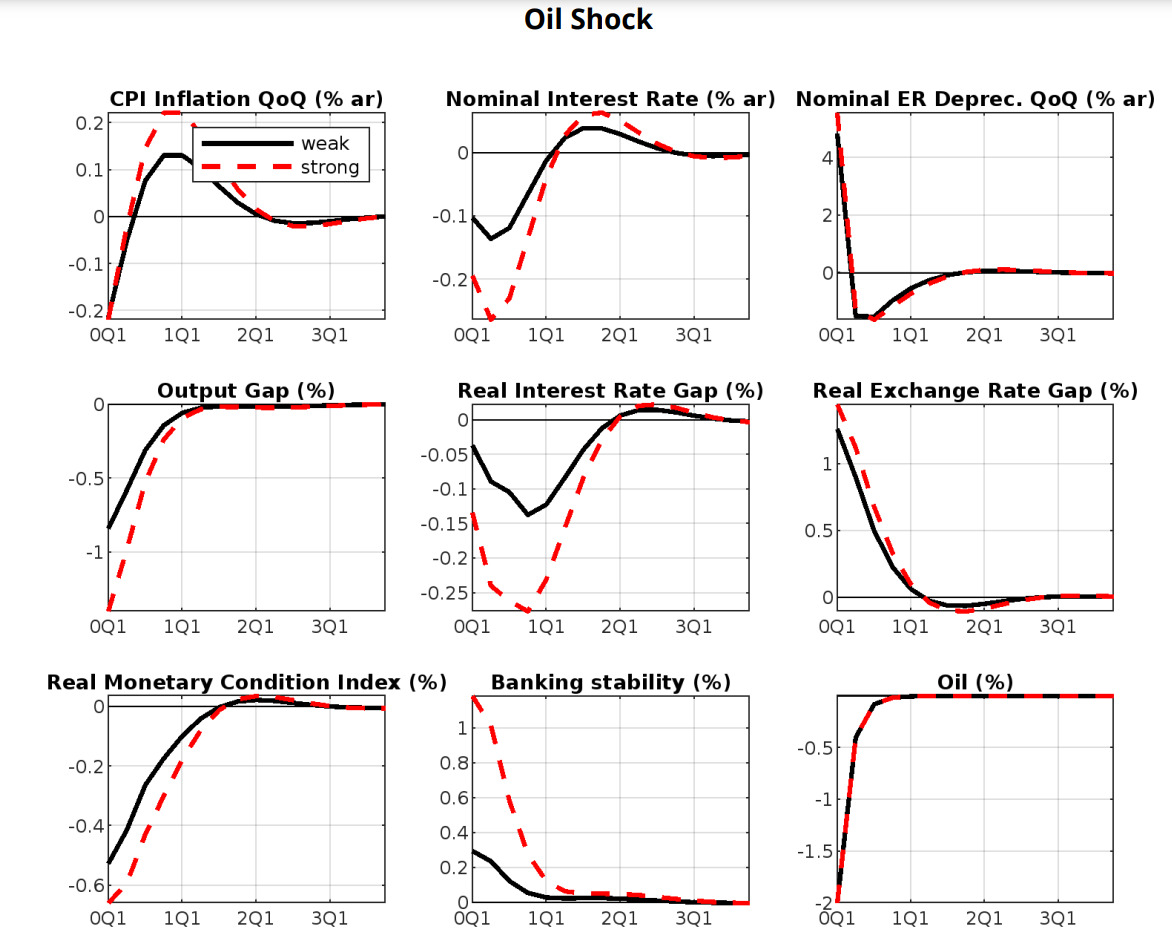
Scenario 1 analysed the effects of a 1.00 percentage point negative shock to oil prices and monetary policy, considering both weak and strong sensitivities of aggregate demand to these shocks.
The impulse response of Scenario 1 provided in Figure 1 indicates a subdued aggregate demand for at least one quarter, contributing to an increase in non-performing loans, which negatively affects the banking system over the same period. Similar findings are reported by Chin et al. (2023) and Alnabulsi et al. (2022) for Kazakhstan and MENA countries. The results further suggest that loosening monetary policy during a decline in oil prices would lead to an increase in inflation for approximately two quarters, followed by a gradual decrease. Initially, there would be a depreciation of the exchange rate and a decrease in the nominal interest rate, resulting in looser monetary conditions. These looser conditions positively impact aggregate demand and, therefore, restore banking system stability after two quarters.
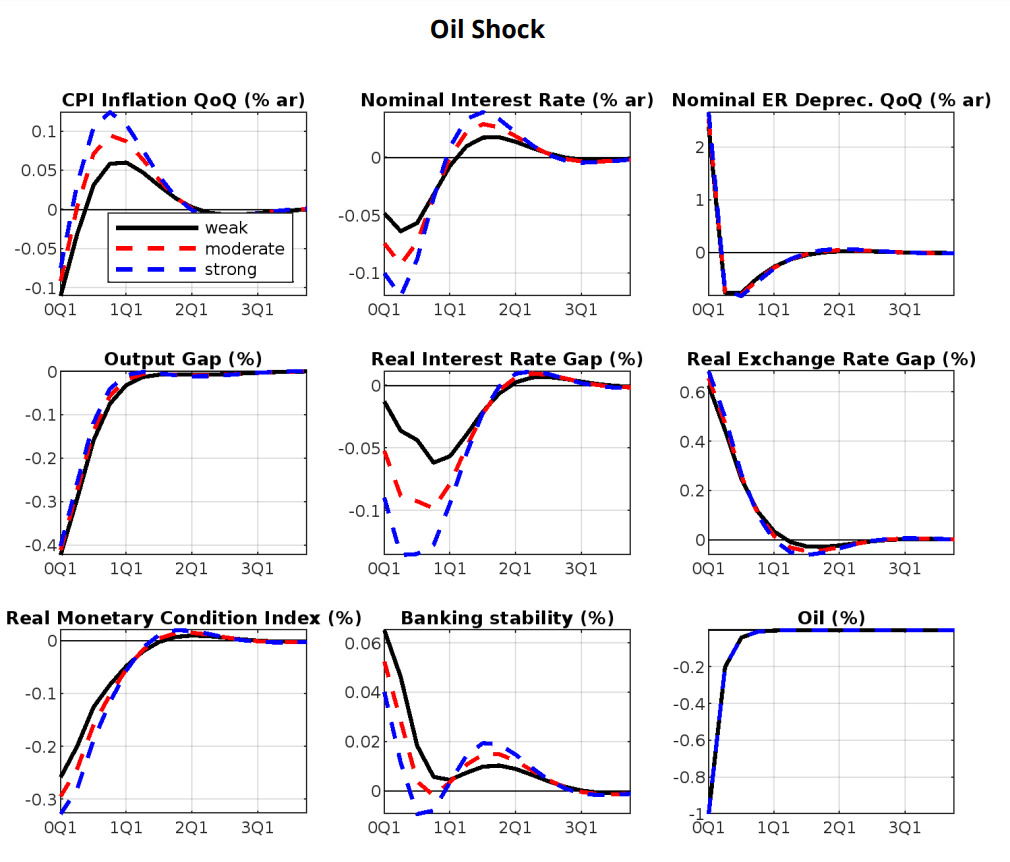
Scenario 2 assessed the effects of positive shocks in oil prices and monetary policy, each by 1.00 percentage points, while considering varying degrees of sensitivity in the response of aggregate demand—weak, moderate, and strong.
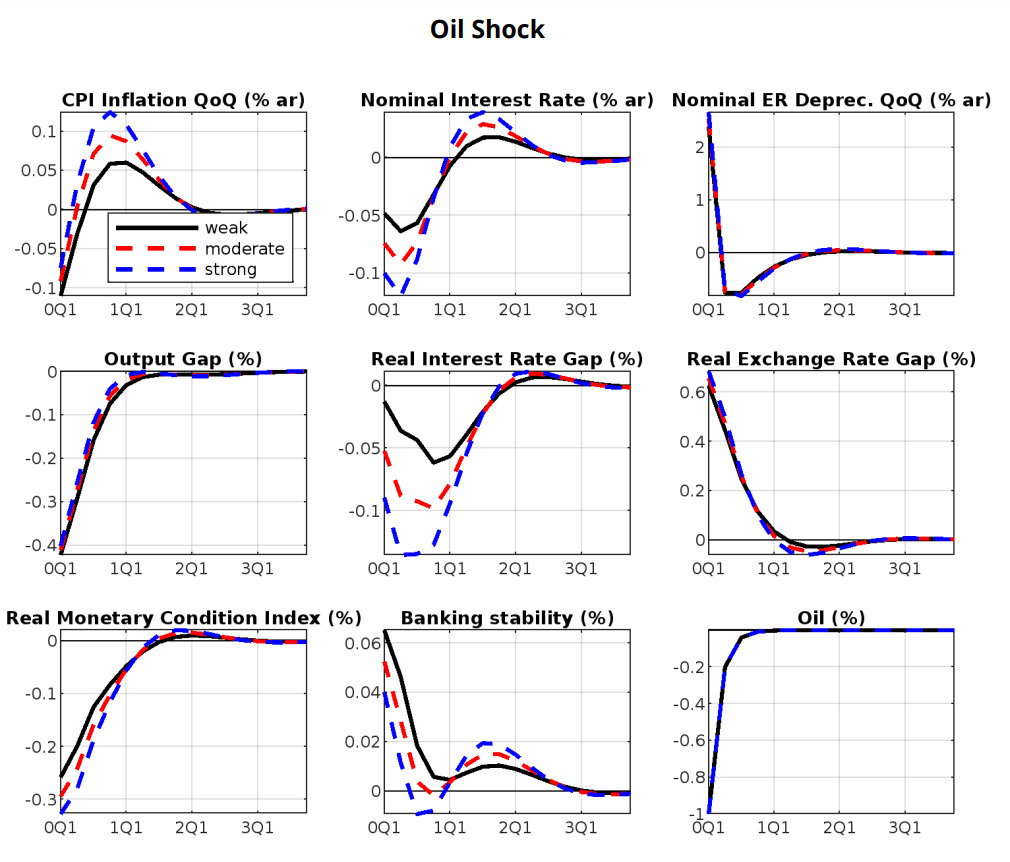
The banking system index experienced a significant decline in response to the oil and monetary policy shocks; nevertheless, this effect diminishes after the second quarter as monetary policy tightens within the same period (Napari et al., 2024), which offers counterfactual evidence relevant to the ECOWAS region. Furthermore, it is revealed in Figure 2 that the oil shock has the potential to restore the economy towards recovery following a decline in aggregate demand; however, this recovery is accompanied by an immediate surge in inflation that persists for approximately two quarters.
.png)
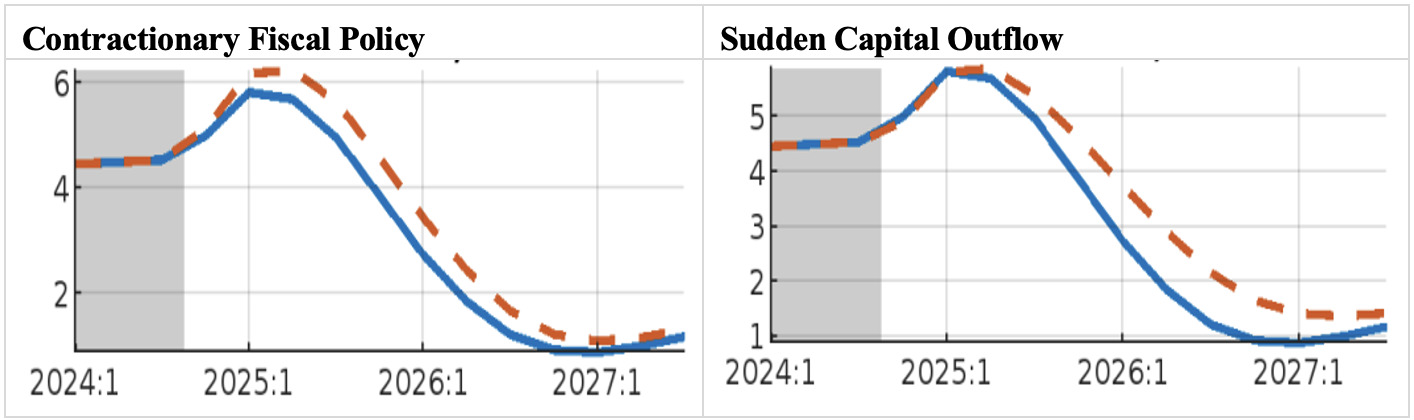
The conditional forecast indicated that if the banking system experiences a negative shock due to falling oil prices and the monetary authorities react by lowering interest rates, this would lead to a sudden outflow of capital, resulting in a slight rise in non-performing loans (see figure 3). This increase is expected to persist over time, reflecting the degree of exposure that deposit money banks have to foreign capital. Conversely, if the government opts to increase taxes to compensate for a shortfall in oil revenue, this will likely exacerbate stress within the banking sector.
IV. Conclusion
The banking system of resource-rich countries is often vulnerable to fluctuations in commodity prices. In Nigeria’s case, most of the credit to the private sector is extended to players in the oil industry, and aggregate demand depends significantly on proceeds from the oil sector. We have therefore demonstrated, under two scenarios, that negative shocks to oil prices would escalate the ratio of non-performing loans (which aligns with the findings of Odu & Sanusi, 2021). However, an expansionary monetary policy response by the central bank could enhance banking stability after approximately two quarters. For future studies, we recommend a disaggregated analysis of the impact of oil price shocks on both small and large banks.