
I. Introduction
Over the last decade, public concern about climate change has increased significantly, largely driven by rising carbon dioxide emissions. This growing awareness has led to greater demand for clean energy sources, such as wind, solar, and geothermal power (D. Li et al., 2024). In contrast, fossil fuels—including coal, crude oil, and natural gas—are increasingly being classified as sources of “dirty energy.”
The importance of clean energy is evident in climate finance. The United Nations Framework Convention on Climate Change (UNFCCC) defines climate finance as local, national, or transnational funding from public, private, and alternative sources aimed at mitigating the adverse effects of climate change, as outlined in agreements like the Kyoto Protocol and the Paris Agreement (D. Li et al., 2024). Extreme climate changes have a detrimental impact on industrial sectors, with measurable spillover effects on financial markets (e.g., Saqib et al., 2023; Wu, 2025). This heightened risk may prompt investors to divest from carbon-intensive firms, which in turn can influence the relationship between clean and dirty stock prices. Despite its importance, few studies have explored climate change awareness as a potential factor driving the dynamic relationships between clean and dirty stocks.
Investment trends underscore the increasing significance of this nexus in both industry and academia. According to the IEA report (2025)[1], investments in clean technologies are expected to soar to $2.2 trillion by the end of 2025, reflecting global efforts to reduce greenhouse gas emissions. Conversely, investments in traditional energy sources are projected to reach only $1.1 trillion. Academic research has shifted toward analyzing the clean-dirty nexus, covering volatility spillovers (e.g., Huang et al., 2025), time-varying correlations (e.g., Bouri et al., 2025), connectedness structure (e.g., A. Li & Zhong, 2025), dependence structure (e.g., Chen et al., 2025), time-frequency coherences (e.g., Tiwari et al., 2023), hedging effectiveness (e.g., Kanjilal et al., 2025), and the identification of key macroeconomic drivers (e.g., Ahmed, 2024). However, the drivers of the clean-dirty nexus have received far less attention, and the role of climate change and extreme events remains insufficiently understood.
This research makes three contributions. First, it is the first to apply a multivariate GJR-GARCH model with dynamic conditional correlation (DCC) to capture clean-dirty correlations. Second, it builds on the work of Santi (2023) by employing the Google Search Trend (GST) approach to create a Climate Change Attention Index (CCAI). Lastly, it introduces a GARCH-X specification (e.g., Caporin & McAleer, 2012) that incorporates the CCAI and extreme events as exogenous variables into both the DCC conditional mean and variance. Together, these contributions advance the literature by revealing how climate attention and extreme events influence the strength and volatility of correlations between clean and dirty stocks.
II. Data and Methodology
A. Data
We use daily data for clean energy and dirty stocks. Clean energy stocks are represented by the S&P global clean energy index (GCEI), which is designed to track the performance of companies worldwide that are involved in the clean energy sector. Dirty stocks are approximated by GOEI, which tracks the performance of the 120 largest companies within the S&P Global Index that are engaged in various aspects of the oil and gas industries. The GOEI is weighted by total market capitalization and was sourced from the S&P Dow Jones Indices database.
The climate change attention index (CCAI) measures the level of public attention devoted to climate change at a given time, with the primary aim of capturing shifts in awareness, sentiment, and concern (e.g., Baur & Oll, 2016). To construct the index, we use Google search trend (GST) data, collected daily for selected climate-related keywords using the Trendecon R package. These keywords are aggregated into the CCAI using principal component analysis (PCA), which reduces dimensionality, filters noise, and produces a robust and interpretable composite indicator (e.g., Da et al., 2011). The resulting index is normalized on a scale from 1 to 100, where lower values indicate reduced public attention to climate risk and higher values denote heightened attention.
The data span from January 30, 2015, to April 4, 2024. The time series were synchronized daily to avoid any lag between the CCAI and the stock indexes. All the time series were converted into logarithmic changes. Both clean and dirty returns exhibit significant deviations from normality, as well as evidence of nonlinearity and heteroscedasticity, thereby confirming the suitability of the GJR-GARCH model (see Table 1).
B. Methodology
We proceed in two steps. In the first step, we employ the multivariate GJR-GARCH (M-GJR-GARCH)[2] model of Glosten, Jagannathan, and Runkle (1993) under dynamic conditional correlation (DCC) to model the dynamic correlations between clean and dirty stocks. The GJR-GARCH model[3] can account for the main stylized facts of return volatility, such as volatility clustering, nonlinearity, and asymmetry. The model has been shown to outperform several other GARCH-class models (e.g., Vijayalakshmi, 2024). Model lag lengths are selected using the Bayesian Information Criterion (BIC) and the Akaike Information Criterion (AIC).
In the second step, the CCAI is incorporated into the conditional mean equation of the DCC-GARCH specification to quantify the impact of climate attention on the strength of clean-dirty correlations. Dummy variables are additionally introduced to capture the effect of extreme events, such as the COVID-19 pandemic (February 11, 2020 – December 31, 2022 ), the Russo-Ukrainian war (RUW) (February 24, 2022 - April 4, 2024), and the related energy crisis in Europe (EUEC) (February 2022 - December 2022).[4] This approach enables us to assess the impact of these events on the stability of the correlations. The DCC mean and variance are specified as follows:
DCCt=α0+β1CCAIt+β2CCAIt−1+ei,t
hij,t=c+ae2ij,t+bhij,t+m∑k=1dkdumk,t
where is the DCC at time (t), and are the current and the one-period lagged values of CCAI, and is a dummy variable indicating a turbulent period.
III. Empirical results
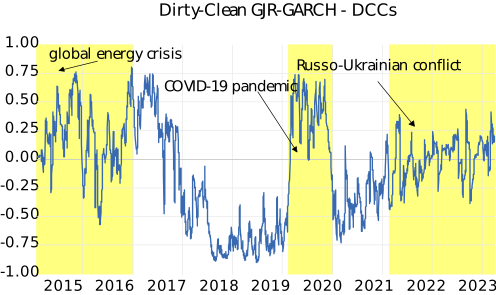
Table 2 confirms the suitability of the M-GJR-GARCH-DCC model for clean–dirty stock correlations, as indicated by the diagnostic tests (Panel C). The ARCH and GARCH components are statistically significant, while the GJR component is negative and significant, capturing the asymmetric effects of positive and negative shocks (Panel B). The average DCC is weakly positive (0.029), suggesting a low but positive correlation between dirty and clean energy stocks. The DCC series also shows substantial volatility, ranging from –0.899 to 0.8014, and strong heteroscedasticity, which justifies the use of a GARCH-X framework.
Figure 1 reports the fluctuating path of the DCCs. During the EUEC and RUW periods, correlations surged, reflecting heightened correlation under stress conditions, while their volatility decreased. In contrast, the COVID-19 period is marked by a notable decline in correlations, suggesting a temporary dissociation between clean and dirty assets. Overall, the results indicate that extreme events have a significant influence on the strength, direction, and volatility of correlations between clean and dirty assets.

To assess the impact of CCAI on clean–dirty DCCs, we include its contemporaneous and lagged values in the GARCH-X mean equation (see Equation (1)). Equation (2) additionally incorporates dummy variables for the selected extreme events. The results of mean equation show that indicating that an increase in CCAI reduces the contemporaneous clean–dirty correlation by 1.68%. Equation (2) produces a consistent estimate of These findings are consistent with those of Li et al. (2024), who also document an adverse effect of CCAI on clean–dirty correlations. This may reflect the tendency of clean energy stocks to benefit from heightened climate awareness, while dirty stocks underperform due to regulatory pressure and shifts in consumer preferences. The conditional variance estimates further show that all three dummy variables are negative and statistically significant at the 1% level, suggesting that extreme episodes reduce DCC volatility. This implies that under stress conditions, investors may engage in indiscriminate selling to mitigate portfolio risk, thereby narrowing the divergence between sustainable and non-sustainable assets. Finally, the Ljung-Box diagnostic indicates no significant autocorrelation in the residuals, confirming that the GARCH-X model effectively captures conditional heteroscedasticity.
IV. Conclusion
This paper investigates how public attention to climate change and extreme events shapes the dynamic correlation between clean and dirty stocks. By implementing a multivariate GJR-GARCH-DCC and a GARCH-X method on recent data, we find that these assets are generally weakly and positively correlated. Climate change attention tends to attenuate the strength of their comovements, while periods of systemic stress reduce the volatility of these correlations.
Our findings suggest a form of decoupling, defined here as the temporary or structural weakening of clean–dirty stock correlations. Temporary decoupling occurs during crisis episodes when uncertainty dominates, while persistent public climate concerns and ESG-driven investment trends may drive more structural decoupling. This distinction refines prior evidence on financial asset comovements and extends the literature on ESG dynamics by identifying climate awareness as a determinant of correlation risk.
For policymakers, these results underscore the importance of managing correlation volatility during periods of heightened uncertainty. Regulatory bodies and policymakers can use such evidence to design climate-resilient financial systems and ESG investment guidelines, ensuring that clean energy markets remain potential diversifiers even during turbulent periods. For investors, the findings indicate that the benefits of hedging between clean and dirty stocks diminish during crises, requiring more adaptive portfolio management strategies.
Future research could further distinguish between structural and transitory drivers of decoupling by incorporating other proxies for climate attention, such as physical risk or transition risk. Extending the study to other asset classes, including green an brown bonds, cryptocurrencies, and tokens, would enhance our understanding of how climate-related dynamics shape financial interconnectedness.
The journal’s readers can refer to Glosten, Jagannathan, and Runkle (1993) for a detailed description.
We estimate various GARCH-class models, including the GARCH, EGARCH, TGARCH, FIGARCH, and ADCC GARCH. The GJR-GARCH model shows the best fit of the data. Estimations of the GARCH-class models and their fitting performance are available upon request addressed to the corresponding author.
A dummy variable is assigned a value of 1 during an extreme event and 0 otherwise.