
I. Introduction
Achieving sustainable development requires balancing economic growth with environmental protection. Sectoral innovation, especially in agriculture, energy, industry, and transportation, is central to this transition, as these sectors account for the bulk of emissions and resource use. Patents serve as proxies for technological progress that enhances efficiency and supports cleaner production (Acemoglu et al., 2012; Popp, 2002).
As the world’s largest CO₂ emitter and a global leader in patent filings, China presents a compelling case to assess how innovation affects environmental outcomes. National initiatives such as the Innovation-Driven Development Plan and Made in China 2025 have catalyzed investment in renewable energy, precision agriculture, and electric vehicles. Yet, it remains unclear whether these innovations lead to tangible emission reductions and under what policy frameworks such outcomes are realized.
Grounded in Schumpeterian and endogenous growth theories (Romer, 1990; Schumpeter, 1934), recent research has explored how green innovation contributes to long-term sustainability. The Porter Hypothesis posits that well-designed environmental regulation can stimulate innovation with dual ecological and economic benefits (Porter & Van der Linde, 1995). Similarly, the Environmental Kuznets Curve (EKC) suggests that income growth may eventually decouple from environmental degradation through innovation and policy reform.
Empirical studies have shown that sector-specific innovations yield varying environmental effects. In agriculture, technologies like precision farming and biotechnology may reduce emissions, though outcomes are context-dependent (Wang et al., 2024). Renewable energy patents are linked to long-term emission reductions (H. Li et al., 2025), while industrial innovation may backfire due to rebound effects such as the Jevons Paradox. Transport-related advances consistently reduce emissions and generate productivity spillovers (Ling et al., 2024).
Despite China’s extensive progress in innovation policy, there remains limited empirical evidence on whether sector-specific technological advancement contributes to emission mitigation under the country’s unique institutional and trade conditions. Previous research often treats innovation as an aggregate phenomenon, overlooking the heterogeneous environmental effects across sectors. This study is motivated by the urgent need to clarify these differential impacts and to provide evidence-based insights supporting China’s green transformation in alignment with SDGs 7 (Affordable and Clean Energy), 9 (Industry, Innovation, and Infrastructure), and 13 (Climate Action).
This study highlights the dynamic interplay between innovation and policy. While moderate policy stringency can stimulate green patenting by creating incentives for cleaner technologies (Jaffe et al., 2002), excessively rigid regulatory frameworks may impose compliance burdens that discourage innovative activity. This study addresses a gap in the literature by systematically analyzing the joint effects of sectoral innovation, policy, and trade openness on China’s CO₂ emissions from 2000 to 2022 using an ARDL framework.
II. Data and Methodology
This study examines the impact of sectoral innovation in agriculture, energy, industry, and transportation on CO₂ emissions in China from 2000 to 2022. Innovation is proxied by sector-specific patent data from EPO PATSTAT, while data on emissions, GDP per capita, trade openness, and environmental policy stringency (scaled 0–6) are obtained from the World Bank and OECD. Together, these variables allow for a comprehensive assessment of how technological progress and policy environments jointly shape China’s environmental outcomes.
To estimate both short- and long-run effects, the study employs the Autoregressive Distributed Lag (ARDL) model, which accommodates small samples and variables with mixed integration orders [I(0), I(1)]. This framework captures dynamic adjustments in the innovation–emissions nexus. The ARDL (p, q) model is specified as follows:
\[\begin{aligned} \Delta CO_{2t} &= \alpha_{0} + \sum_{i = 1}^{p}\beta_{i}\,\Delta CO_{2,t - i}\ + \sum_{j = 0}^{q}\gamma_{j}\,\Delta X_{t - j}\\ & \quad + \phi\, CO_{2,t - 1} + \psi\, X_{t - 1} + \varepsilon_{t}. \end{aligned}\tag{1}\]
where CO₂ represents per capita emissions and is the vector of explanatory variables:
\[\begin{aligned} X_{t} = \left( \begin{array}{l}GDP_{t},\, AGR_{t},\, IND_{t},\, RENEW_{t},\,\\ TRANS_{t},\, EPS_{t},\, TO_{t} \end{array} \right) \end{aligned}\tag{2}\]
where GDP denotes income level, AGR, IND, RENEW, and TRANS indicate innovation patents in agriculture, industry, renewable energy, and transportation, respectively. EPS measures environmental policy stringency, TO is trade openness, and is the error term. The parameters and represent short-run adjustments, while and capture the long-run equilibrium relationship.
Table 1 summarizes the variables’ distribution and correlations. Skewness and kurtosis values indicate approximate normality. CO₂ emissions show weak, mostly negative correlations with innovation, implying modest mitigation effects. Income correlates positively with innovation across sectors, while trade openness relates negatively to agricultural innovation and EPS, suggesting trade–environment trade-offs. Descriptive statistics are reported in raw values, while the subsequent analysis uses log-transformed variables to enhance interpretability and reduce heteroscedasticity.
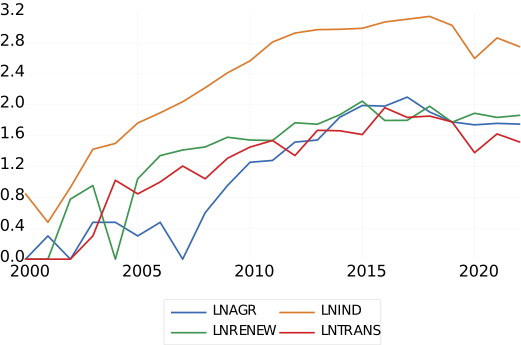
Figure 1 illustrates the evolution of sectoral innovation patents in China from 2000 to 2022. Industrial patents dominate, peaking in 2015 and declining slightly after 2020. Renewable and transport innovations rise sharply after 2005, reflecting the implementation of the Renewable Energy Law (2005) and subsequent green technology subsidies. The rapid growth of renewables after 2010 aligns with China’s “12th Five-Year Plan,” which prioritized low-carbon industries. Agricultural patents display steady but modest growth, partly supported by the National Modern Agriculture Innovation Program (2012). The post-2020 decline in industrial and transport patents likely reflects COVID-19 disruptions and temporary reallocation of R&D resources, while agriculture and renewables remain relatively stable.

III. Empirical Findings
Table 1 indicates that most variables are non-stationary in levels but become stationary after first difference, confirming they are integrated of order one, I(1). While a few variables (LNCO, LNIND) are stationary at level under some specifications, the overall mixed integration justifies the use of the ARDL approach, which accommodates I(0) and I(1) series.
Table 1 also confirms a valid long-run relationship, with the ARDL bounds F-statistic (10.57) exceeding the 1% critical value. Diagnostic tests support model robustness: no issues of misspecification (RESET), serial correlation (Breusch-Godfrey), or heteroskedasticity (Breusch-Pagan). Residuals are normally distributed (Jarque-Bera), and VIF values indicate no multicollinearity.
Table 2 presents the short- and long-run estimates of the ARDL model. In the short run, income (LNGDP) exerts a negative and statistically significant impact on CO₂ emissions, indicating that rising income levels contribute to improved energy efficiency and cleaner production. Industrial innovation and trade openness have significant positive effects on emissions, while renewable and transportation innovations show negative and statistically significant relationships, confirming their short-term mitigation roles. EPS and agricultural innovation remain insignificant. The error correction term is negative and highly significant, confirming a stable long-run relationship. It suggests that approximately 51.5% of short-run deviations are corrected each period, guiding the system toward equilibrium. The model’s high R-squared value further indicates strong explanatory power.
In the long run, income continues to exert a negative and statistically significant effect on CO₂ emissions, consistent with the EKC hypothesis, whereby economic growth initially increases but later reduces environmental degradation through structural transformation and technological upgrading. Renewable and transport innovations sustain their emission-reducing effects, reinforcing their importance for long-term decarbonization. Conversely, industrial innovation and trade openness have significant positive long-run effects on emissions, while agricultural innovation and environmental policy stringency remain statistically insignificant.
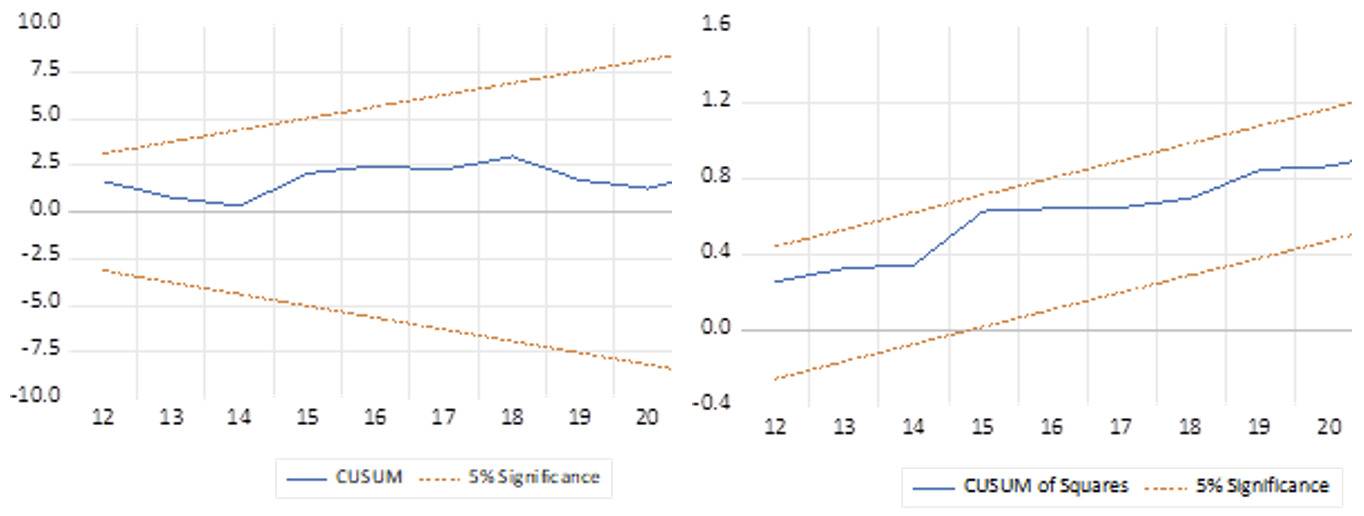
Figure 2 presents CUSUM and CUSUMSQ test results, confirming the ARDL model’s structural stability. Test lines stay within 5% bounds, with no structural breaks detected, even during the 2008 crisis or COVID-19, supporting the model’s robustness and long-run reliability.
To contextualize these findings within the broader literature, our empirical results demonstrate strong alignment with prior studies emphasizing the environmental benefits of sectoral innovation, particularly in renewable energy and transportation. Consistent with Abbas et al. (2024), the negative association between renewable energy patents and CO₂ emissions reflects the effectiveness of clean energy innovation, echoing the role of policy-driven patenting discussed by Coussa et al. (2024) and the nonlinear dynamics highlighted by Li et al. (2025).
Likewise, our findings are in line with Li et al. (2024) on electric vehicle subsidies, Wang et al. (2024) on public transport infrastructure, and Ling et al. (2024) on knowledge spillovers that enhance productivity and sustainability. In contrast, a positive link between industrial patents and emissions concurs with Xie and Teo (2022), reflecting the Jevons Paradox and concerns over low-value-added innovation. For agriculture, the results correspond with Wang et al. (2024), who underline indirect environmental benefits via food security and diffusion. Regarding EPS, our findings diverge from Yan et al. (2024), who report positive effects on green patenting, but are consistent with Hasan and Du (2023), who highlight enforcement and financing gaps.
Finally, the negative long-run effect of income level supports the EKC hypothesis, suggesting income-driven decoupling of emissions, while the positive impact of trade openness, in line with Wen and Zhu (2024), raises concerns over scale effects and environmental leakage.
IV. Conclusion
This study explored the impact of sectoral innovation patents on CO₂ emissions in China from 2000 to 2022 using an ARDL framework. Results show that renewable energy and transportation innovations significantly reduce emissions, while industrial innovation and trade openness increase them, particularly in the absence of strong regulatory oversight. Agricultural innovation, though vital for food security, has no direct long-run effect. The findings indicate a conditional EKC pattern in which rising income eventually supports decarbonization through structural transformation and the adoption of cleaner technologies. However, the insignificant effect of EPS reveals a gap between policy design and practical enforcement, underscoring the need for more coherent regulatory frameworks, stronger monitoring, and improved financing mechanisms for green innovation. The results highlight that achieving China’s long-term climate goals requires not only expanding innovation capacity but also strategically directing innovation toward sectors with the greatest mitigation potential.