
I. Introduction
Climate change poses a critical global issue, impacting the environment, economy, and human well-being through global warming, extreme weather events, and energy insecurity. Each 1°C increase in global warming costs the world 12% of its incremental GDP (World Economic Forum, 2024), underscoring the fiscal burden. Therefore, addressing climate change is not merely an environmental concern but also a fiscal necessity. According to the United Nations (2022), fossil fuels are the key factor in climate change. Additionally, fossil fuel sources are subject to geopolitical supply shocks and price volatility compared to renewable energy (International Energy Agency, 2023). Despite this, around US$7 trillion was allocated in 2022 to subsidize fossil fuels, while attaining carbon neutrality by 2050 requires spending US$4.5 trillion per year in renewable energy investment until 2030, potentially saving US$4.2 trillion yearly through reduced pollution impacts and costs (United Nations, 2025). Thus, transitioning to renewable energy is a sustainable alternative energy source. As a result, the world is rechanneling investment flows to renewable energy technologies to attain the goals of the Paris Agreement (Intergovernmental Panel on Climate Change, 2014). However, significant capital investment is needed for renewable energy technologies compared to fossil fuels (Hirth & Steckel, 2016), and the associated investment risks often deter large-scale private investment in this sector (Energiewende, 2018).
Given these challenges, understanding the fiscal implications of renewable energy adoption is essential. Prior studies have analyzed the impact of investment in renewable energy on public debt levels, including both fiscal stress (Auteri et al., 2024; Khan et al., 2025) and fiscal savings through a reduction in public subsidies (Auteri et al., 2024; Taghizadeh-Hesary & Rasoulinezhad, 2025). However, the specific effect of public investment in this sector on government debt remains underexplored. To address this research gap, the present study examines whether public investment in renewable energy is fiscally sustainable or contributes to rising government debt. It adopts a comprehensive framework that links renewable energy investment, public debt, and macroeconomic conditions to provide a more holistic understanding. In doing so, the study offers empirical evidence to inform the ongoing debate on balancing environmental and fiscal sustainability.
The reminder of the paper is organized as follows. Section II provides a review of the literature, Section III discusses the methodology and data used in this study, followed by Section IV which presents main findings. The final section concludes the paper.
II. Literature Review and Conceptualization
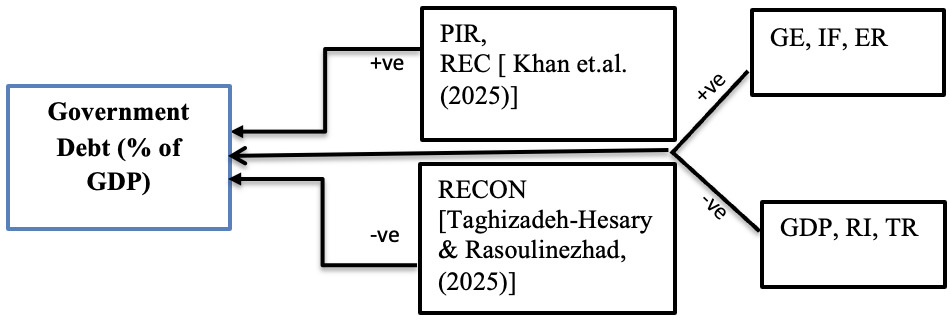
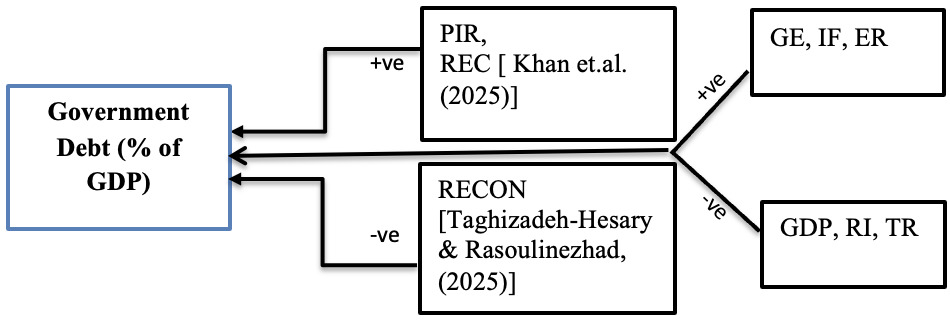
The study by Khan et al. (2025) demonstrates that while both renewable energy intake and output benefit the environment, they often lead to increased public debt levels. Auteri et al. (2024) find a bidirectional relationship: public investment in renewable energy raises government debt, and rising debt, in turn, negatively affects investment in renewable energy infrastructure and consumption. From an investment perspective, Hirth & Steckel (2016) highlight the capital-intensive nature of renewable energy investments, while Energiewende (2018) notes the high investment risks in this sector, which discourage private investment and thus increase the burden on public finances.
In contrast, Taghizadeh-Hesary & Rasoulinezhad (2025) suggest that increasing renewable energy consumption can alleviate fiscal burdens by reducing fossil fuel subsidies, import costs, and pollution-related expenses, implying long-term fiscal gains despite initial costs. This aligns with Pigouvian externality theory, which posits that policies promoting clean energy help internalize environmental costs and thereby reduce future fiscal burdens associated with pollution and fossil fuel dependence.
Economic expansion can further support this transition. Gozgor et al. (2020) find that growing economies are more likely to adopt renewable energy over conventional sources. Yang et al. (2019) emphasize the need for calibrated public investment and subsidies in this sector. Broader macroeconomic factors, such as interest rates (Adrian et al., 2024) and exchange rates (Ouhibi & Hammami, 2020), also influence government debt and the capacity to finance renewable energy investments.
Although these studies offer valuable insights, few explicitly examine how government investment in renewable energy affects fiscal outcomes. Building on these studies, the conceptual framework (Figure 1) illustrates the hypothesized relationships among government investment in renewable energy, macroeconomic variables, and government debt.
III. Data and Methodology
The study uses an annual dataset (2000–2023) for a panel of 44 countries selected based on data availability. Table 1 describes the variables. In this study, GD is the dependent variable and PIR, REC, RECON, GE, IF, ER, GDP, RI and TR are explanatory variables.[1] Based on the evidence from Pesaran’s cross-sectional dependence (CD) test (Pesaran, 2021), we observed that our panel is cross-sectionally dependent, which prompts us to use the CIPS test to check for stationarity (Pesaran, 2007). The CIPS test confirms stationarity at first difference. We then employ the Pedroni cointegration test (Pedroni, 2004), which indicates a long-term association among variables. Furthermore, the study performs several relevant diagnostic tests: the VIF test to check for multicollinearity, the Wooldridge test to check for autocorrelation, the modified Wald test to assess group-wise heteroskedasticity, and the Hausman Test (Hausman, 1978) to choose between fixed and random effects models. The Durbin-Wu-Hausman test confirms that PIR and REC are endogenous. To address endogeneity, the study deploys the IV two-stage least squares (2SLS) method, which provides consistent results in the presence of endogeneity.
Selecting instruments for the endogenous variables is challenging, as an external instrument may create weak instrument issues if it is not correlated with the endogenous variables. Therefore, the study constructs an instrumental variable by taking lagged values of the endogenous variables (Azam et al., 2020), using the second lag of the endogenous variable as an instrument, as recommended by Hossain (2024). To ensure the instruments are valid and strong, this study employs the Kleibergen-Paap test and the Cragg-Donald-Wald F statistic (Cragg & Donald, 1993), both of which should exceed the Stock-Yogo threshold (Stock & Yogo, 2005). These diagnostic statistics confirm that the instrumental variables are correlated with the endogenous variables and are strong IVs. Additionally, to ensure the robustness of the findings from the IV 2SLS method, we use the Control Function Approach (CFA), which addresses the endogeneity problem (Wooldridge, 2015). This method involves estimating the regression between the endogenous variables and their instruments and including the residuals in the main equation, providing an additional robustness check.
The structural equation estimated using the IV 2SLS approach is as follows:
lnGDit=β0+β1lnPIRit+β2lnRECONit+β3lnRECit+β4lnGDPit+β5lnIFit+β6lnRIit+β7lnERit+β8lnGEit+β9lnTRit+uit
Subscripts and represents cross-sections and time periods, respectively. Further, is the intercept term and represent the elasticity parameters to be estimated, and is the independent and identically (i.i.d.) error term.
IV. Results
Table 1 presents the descriptive statistics. It is observed that all variables have a positive mean. Variables such as and exhibit relatively higher variability compared to variables namely, and Log transformations have been applied to all variables for reliable interpretation, as this reduces the influence of outliers and skewness. The VIF test indicates the absence of multicollinearity.
Table 2 details various pre-diagnostic test results. The findings show cross-sectional dependence in the panel, prompting the use of the second-generation panel unit root test (CIPS). All variables become stationary after first-differencing. The Pedroni panel cointegration test (Pedroni, 2004) validates the existence of a long-term equilibrium relationship among the variables.
Table 3 provides insightful evidence concerning the fiscal implications of government expenditure on renewable energy. Findings from the IV 2SLS model indicate that (0.863) significantly increases government debt, reflecting the large initial expenditures associated with developing renewable infrastructure such as wind farms, solar parks, and grid systems. In contrast, (-0.087) shows a statistically significant negative relationship with public debt, indicating that high consumption of renewable energy may reduce reliance on fossil fuels, thereby lowering fossil fuel-related expenses on subsidies and imports. This is consistent with the findings of Taghizadeh-Hesary & Rasoulinezhad (2025). (0.173) is found to be positively related to government debt accumulation, suggesting that renewable energy capacity expansion in these countries has been led by the government, putting pressure on the fiscal position due to the high capital intensity of such investments, which aligns with the findings of Khan et al. (2025). (-0.733) is negatively associated with public debt, indicating that stronger economic performance improves fiscal space. (0.679) shows a positive effect on government debt, reflecting that efficiency in governance can build public confidence, allowing the government to undertake large-scale public investments and finance them through debt. Both and are positively related to public debt levels, whereas real interest rate is negatively related. This is consistent with theoretical foundations, which suggest that high borrowing costs discourage excessive public debt accumulation. does not show any statistically significant relationship with government debt level. All findings are confirmed by the CFA model as well, which demonstrates robustness.
V. Conclusion
This study documents that government investment and green energy capacity expansion increase government debt, primarily due to high initial upfront costs. In contrast, higher renewable energy consumption appears to contribute to a reduction in public debt through lower fossil fuel subsidies and import expenses. Economic growth, trade, and real interest rates are found to support fiscal space, while factors such as inflation, exchange rate, and government effectiveness raise government debt levels.
The findings of the study suggest several policy implications. First, governments in these countries should adopt a cautious and calibrated approach to public investment and capacity expansion in renewable energy. Second, measures such as consumption-based subsidies and tax incentives should be promoted to encourage renewable energy consumption. Third, investment strategies should include risk mitigation techniques like inflation-indexed financing and currency hedging. Finally, these strategies should be coupled with growth-promoting policies, energy-efficient initiatives, and skill development programs.
Despite providing important policy insights, the study has limitations. We considered only 44 countries worldwide, depending on the availability of data for all key variables, which may result in selection bias. The analysis focused solely on public investment, overlooking the role of the private sector. Future studies should explore sector-specific dynamics (such as solar and wind) and conduct cost-benefit analyses across different segments.
This study offers timely evidence on how green investments and fiscal sustainability interact. It highlights how well-calibrated renewable energy policies can simultaneously advance environmental goals and strengthen public finances, thereby contributing to the fiscal–environmental sustainability debate at a critical juncture.
All variables are described in detail in Table 1.