
I. Introduction
Alignment with presidential policies has been shown to affect firms’ investment decisions (Julio & Yook, 2012) and exposure to uncertainty (Douidar et al., 2023). Motivated by recent work that documents a “Trump effect” on the stock market due to his tough stance on climate change (Cosma et al., 2025), this paper examines the market response to green and brown stocks in the energy sector following the election of Donald Trump as the 45th president of the U.S. Specifically, we examine the response of alternative energy stocks to the 2024 presidential election. By doing so, we provide novel insight into the debated resilience of sustainable investments against market shocks (Albuquerque et al., 2020), with a focus on the energy sector.
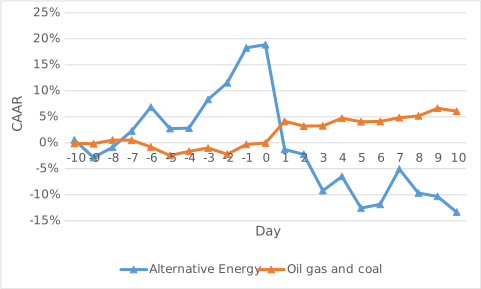
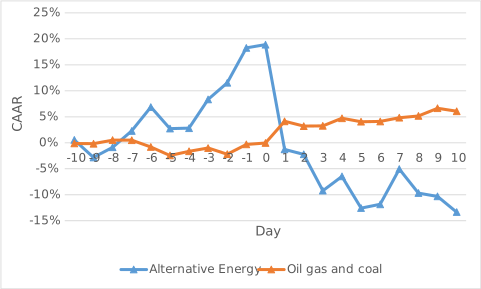
Utilizing an event study on a sample of 1,256 stocks listed on the NYSE and NASDAQ, we document a significant asymmetry in investors’ response to the negative election shock regarding their energy stock trades. Alternative energy stands out as the biggest loser, with cumulative abnormal losses as low as -30.8% during the first week following the election. Interestingly, alternative energy stocks enjoyed positive abnormal returns prior to the election, perhaps in anticipation of a Democratic win, reflecting the speculative motivations behind green trades (Polat et al., 2024). In contrast, brown energy firms, those in the oil, gas & coal sector—enjoyed positive abnormal returns, highlighting the asymmetric impact of Trump’s anti-climate narrative on the energy sector and investors’ strategy to capitalize on this climate-negative political shock.
Further analysis shows that firms with higher ESG ratings are negatively affected by the election, which in turn contributes to the asymmetry in the market response toward green and brown energy firms following the election result. Interestingly, although ESG performance across the whole sample of stocks is found to have a negative effect on abnormal returns, ESG performance is found to have a positive marginal impact among brown energy stocks. This suggests that investors do not necessarily ignore ESG considerations in their valuation of energy firms, particularly when it comes to brown energy stocks, as they reassess firm valuations in response to governmental policies expected to change drastically, as is the case with Trump’s political campaign. Overall, the findings indicate that investors generally overreacted to the negative political shock, particularly in their trading of alternative energy stocks, and did so in an asymmetric manner for green and brown energy firms.
The remainder of the paper is structured as follows: Section II presents the data and methodology. Section III discusses the findings from the event study and regression analysis. Section IV concludes.
II. Methodology and Data
Our sample consists of 1,256 stocks listed on the NYSE and NASDAQ, for which ESG data is available via Datastream. Daily stock return data, along with firm-level control variables including ESG scores, are collected from this source. Table 1 presents the sectoral distribution of the 1,256 stocks in the sample, with Technology accounting for 34.7% of the total market capitalization, while Financials have the highest number of listed stocks.
We use the event study methodology to explore the stock market impact of Trump’s election results, with a particular focus on the energy sector. Given that our focus is on the economic impact of Trump’s election, we set the event date (𝑡 = 0) as the U.S. presidential election held on November 5, 2024. Note that the estimation window used for expected return computation is [−250, −26], following Cosma et al. (2025). Using the market model to calculate the abnormal return for each stock, we compute cumulative abnormal returns during the event window [p, q]. We consider eight different windows covering the period to
Finally, we perform cross-sectional regression analysis to investigate the impact of firm-level factors, including the ESG score, on the abnormal returns due to the election shock. For this purpose, we estimate the following model:
CARi,p−q=β0+β1ESGi,t+γXi,t+εi,t
where is the ESG score of firm i and 𝑋𝑖,𝑡 is the vector of firm-level control variables which includes natural logarithm of market value of equity (Size), the price-to-book value (PB), dividend yield (DY), and return on assets (ROA).
III. Empirical Results
A. Event study results
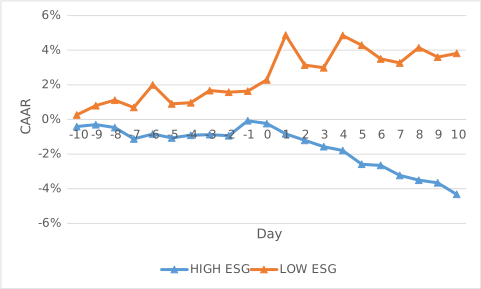
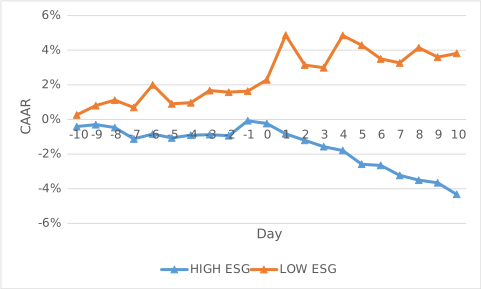
As depicted in Figure 1, high and low ESG firms are asymmetrically impacted by Trump’s election victory, with low ESG firms generally exhibiting a positive response following the election, while high ESG firms show negative abnormal returns. The difference in cumulative average abnormal returns (CAAR) for low and high ESG firms, as presented in Table 2, is positive and highly significant, suggesting that investors repriced high ESG performers downward in response to the election results. This finding aligns with recent evidence from Wei et al. (2025), which suggests that the new administration’s anti-ESG narrative was strongly reflected in the stock market.
The asymmetric impact of the election is even more evident in the energy sector, as depicted in Figure 2. As shown in Table 2, while alternative energy stocks experienced positive abnormal returns during the pre-election period—possibly in anticipation of a democratic win that would continue green initiatives—stocks in this sector suffered heavy abnormal returns following the election. The abnormal return during the first week after the election is as low as -30.8%, indicating a risk premium on green stocks. This is not unexpected, as Trump’s agenda is characterized by anti-climate change slogans that emphasize deregulation in the energy sector. Interestingly, the positive abnormal returns on alternative energy stocks prior to the election partly reflect speculative motivations behind green trades (Polat et al., 2024). Clearly, speculative trades on alternative energy represented a significant election bet on this sector, which ultimately failed. In contrast, brown stocks, represented by the oil, gas & coal industry, enjoyed positive abnormal returns following the election, with a 4.5% abnormal return on day 1. This result is consistent with recent evidence from Cosma et al. (2025), although their work does not differentiate between green and brown energy companies.
B. Determinant analysis
The findings so far point to a significant asymmetric market response to the election shock, particularly across green and brown firms in the energy sector. To provide further insight into the firm-level determinants of abnormal returns, we present the estimates obtained from Equation (1) in Panel A of Table 3. The negative effect of ESG score observed, particularly for post-election abnormal returns, aligns with the earlier finding that high ESG firms were generally negatively affected by the election result, owing to the anti-DEI (diversity, equity, inclusion) stance taken by the new administration. This suggests that ESG performance has become a political liability, creating a risk exposure for these firms. Interestingly, firm size also stands out as another significant determinant of abnormal returns, with a greater negative impact for large firms, most likely because firms with more comprehensive ESG initiatives tend to be relatively large and have greater resources.
We estimate two modified versions of Equation 1. In the first version, we add dummy variables DUMO and DUMA, which represent the oil, gas & coal and alternative energy sectors, respectively, to Equation (1). In the second version, besides these two dummy variables, we also add their interaction with the ESG variable. For brevity, we only report the coefficient estimates of the dummy variables and the interaction terms in Panels B and C of Table 3.
The results reported in Panel B of Table 3 further highlight the asymmetric impact of the election on the energy sector. Both DUMO and DUMA variables—representing the oil, gas & coal and alternative energy sectors, respectively—take on significantly positive signs during the pre-election period, likely due to speculative trades on energy stocks in anticipation of the election outcome. As noted earlier, the impact on alternative energy is significantly higher, as implied by the larger coefficients observed for DUMA. During the post-election period, however, these two energy subsectors significantly diverge, with a positive (negative) coefficient for DUMO (DUMA), highlighting the asymmetric market response for green and brown energy firms. To further examine whether ESG performance within the energy sector has any impact on the observed abnormal returns, we observe in Panel C of Table 3 that the ESG score plays no role for alternative energy firms during the post-election period, as indicated by the insignificant estimates for DUMA*ESG. In contrast, the positive impact on brown stocks during this period, implied by the positive and significant DUMO*ESG estimates, suggests that investors still accounted for ESG performance in their revaluation of brown energy stocks.
In this study, we conduct an event study to examine the stock market response of the energy sector following Trump’s election victory. Our results show that while firms with high ESG ratings are negatively affected by the election shock, the biggest loser is the alternative energy sector, as the market overreacted to this negative climate event, resulting in an abnormal return as low as -30.8%. In contrast, brown energy firms, those in the oil, gas & coal sector experienced positive abnormal returns, highlighting the asymmetric impact of Trump’s anti-climate narrative on the energy sector. Interestingly, ESG performance in the brown energy sector is found to have a positive impact on abnormal returns, suggesting that investors do not necessarily ignore ESG considerations in their valuation of energy firms, although a green orientation seems to be a political liability. These findings call into question the resilience of green stocks against market shocks.