
I. Introduction
International trade and energy security have become closely interlinked. In the context of globally integrated supply chains encompassing fuels, technologies, and cross-border infrastructure, trade tensions impact physical availability, price dynamics, and the advancement of clean energy deployment. The concept of “security” now extends beyond traditional fuels to include the resilience of clean-energy supply chains and critical materials projects (WTO, 2023). The 2018 escalation between the U.S. and China, triggered by U.S. tariffs and subsequent Chinese retaliation, demonstrated these macroeconomic interconnections; the International Monetary Fund estimated cumulative global GDP losses at approximately 0.8% by 2020, highlighting the significance of tariff shocks (Gopinath, 2019).
In early 2025, a new cycle of tariffs, implemented under national emergency authorities and met with reciprocal actions, reintroduced considerable uncertainty to global value chains (CRS, 2025). From an energy systems perspective, the inclusion of metals, automobiles, industrial equipment, and power-sector components increases capital and input costs across both hydrocarbons and renewables. Beyond primary tariffs, additional measures including tariff-rate quotas on grid equipment, anti-subsidy and safeguard investigations (such as WTO rebalancing), export licensing for strategic minerals, anti-circumvention inquiries related to solar supply chains, and adjustments to rules of origin or local content requirements, create tariff-equivalent barriers (UNCTAD, 2024). Through the lens of international political economy, realist perspectives underscore the strategic leverage of energy access and routing, while institutionalist approaches emphasize rule-based cooperation as a check on opportunistic behavior (Colgan & Hinthorn, 2023). These frameworks collectively clarify how policy shocks affect the Four A’s of energy security: availability, accessibility, affordability, and acceptability (Cherp & Jewell, 2014).
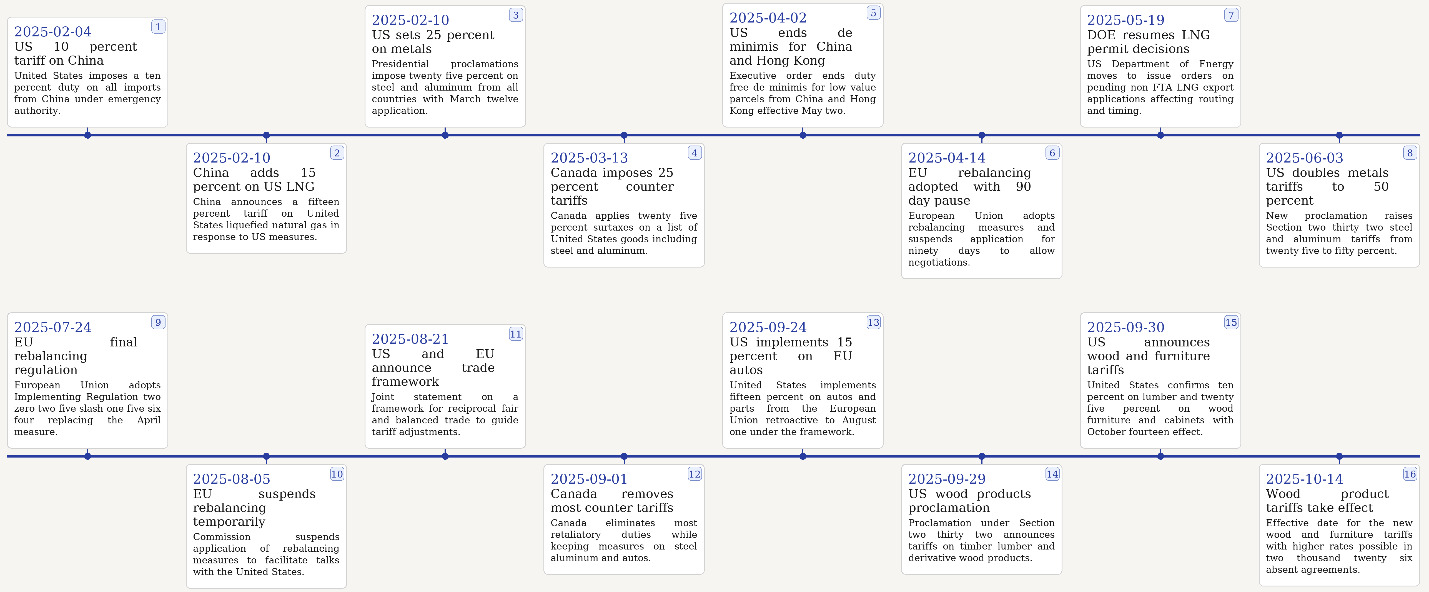
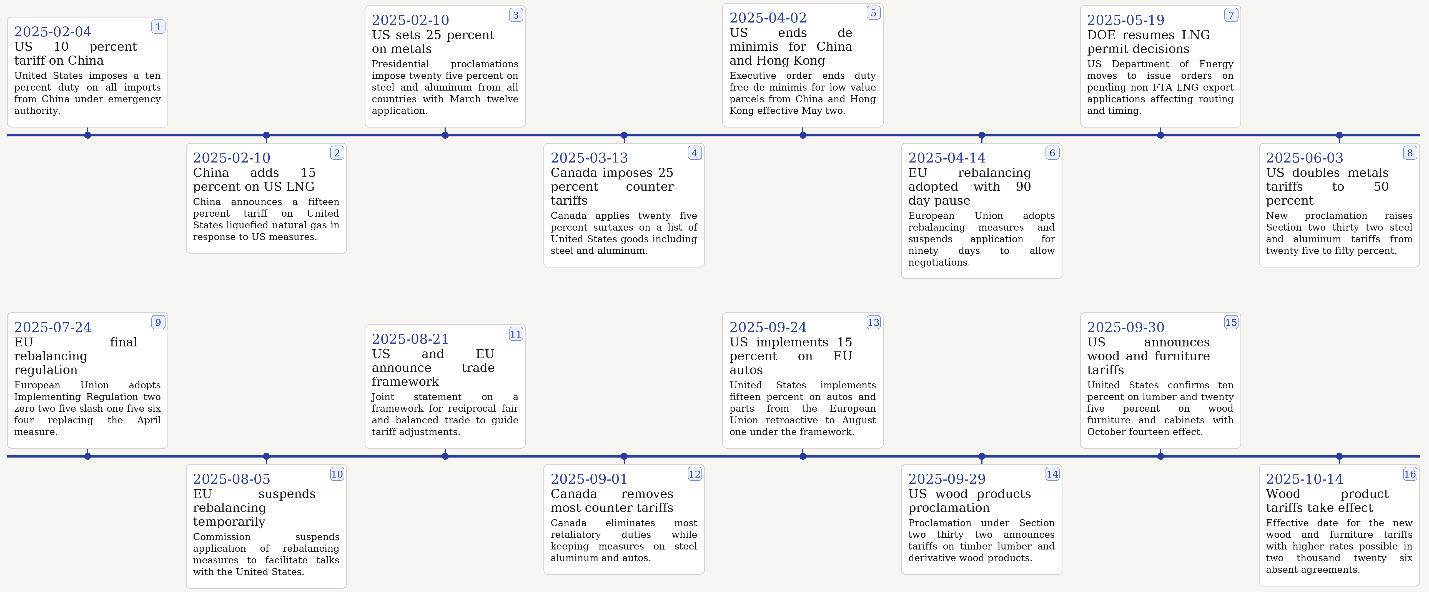
Figure 1 presents a chronological timeline of the documented 2025 tariff dispute, outlining U.S. initiatives and countermeasures adopted by China, the European Union, Canada, and other countries, with particular attention to energy-related inputs. The analysis assesses four transmission channels: changes in the prices of energy-related inputs and equipment; geopolitical consequences and the rerouting of energy trade, particularly LNG; changes in investment timing and risk; and effects on technology deployment. The resulting estimates are sensitive to the timing, rates, and scope of the tariffs.
The remainder of the paper is organized as follows. Section II develops the theoretical framework by linking economic statecraft, weaponized interdependence, and the Four A’s of energy security. Section III presents the main findings, examining the effects of the tariff war on energy availability, accessibility, affordability, and acceptability in China, the European Union, and the United States, as well as the implications for developing economies and the future of global energy security. Section IV concludes by summarizing the principal findings and their broader policy implications.
II. Theoretical Framework
Trade policy serves as a key instrument of economic statecraft, employing commercial measures to exert geopolitical influence without reliance on direct force (Baldwin, 2020; Drezner, 2021). In the context of energy security, four central pillars are repeatedly emphasized, availability, accessibility, affordability, and acceptability - with growing contemporary focus on resilience during the ongoing energy transition (Cherp & Jewell, 2014). Under this framework, tariff escalations and trade frictions disrupt supply chains, increase costs for inputs and capital (such as metals, industrial machinery, and power components), and heighten investment risk. These dynamics unsettle the delicate balance between security and affordability, while intensifying price volatility and capacity limitations across both fossil fuel and clean energy systems (Gopinath, 2019; IMF, 2023).
From a theoretical standpoint, realism regards trade policy as an extension of national power and energy access as a strategic tool; in contrast, institutionalism highlights the role of multilateral agreements (e.g., the WTO) in curbing opportunistic behavior and stabilizing trade flows (Goldstein et al., 2007). The concept of weaponized interdependence illustrates how states that control network chokepoints, whether financial, digital, or commodity-based—can project significant influence. For instance, in 2023, the U.S. leveraged its expansive financial reach and position as the largest LNG exporter to influence energy outcomes and bolster partner resilience during crises (Farrell & Newman, 2019). Throughout the 2020s, governments explored strategies such as friend-shoring and regional clustering to mitigate exposure risks. However, evidence suggests that widespread reshoring can be costly and does not necessarily provide greater resilience than diversified openness; instead, it may exacerbate disparities between advantaged and vulnerable economies (IMF, 2023; WEC, 2024).
This analytical framework informs our examination of how the 2025 tariff conflict is transmitted through economic, geopolitical, investment, and technological channels within both clean and fossil energy landscapes, shaping future security considerations.
III. Main Findings
If the tariff conflict persists, nations are expected to reassess their energy geopolitics and adapt their supply and demand strategies accordingly. Such strategic modifications will directly influence core aspects of energy security (Goldstein et al., 2007). The most substantial impacts are anticipated in the U.S., the European Union, and China, as they represent the primary parties involved in the dispute. Furthermore, developing countries may encounter increased vulnerabilities stemming from these tariff tensions, particularly regarding renewable energy.
A. Effects of the tariff war on energy availability and accessibility
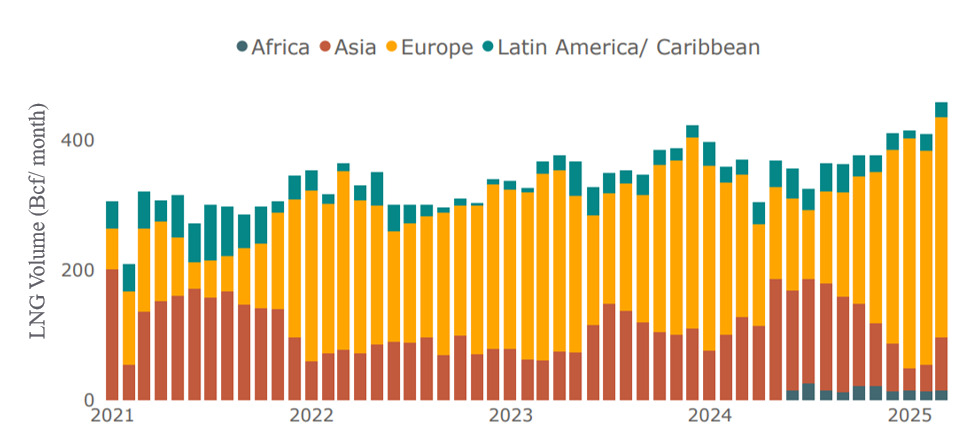
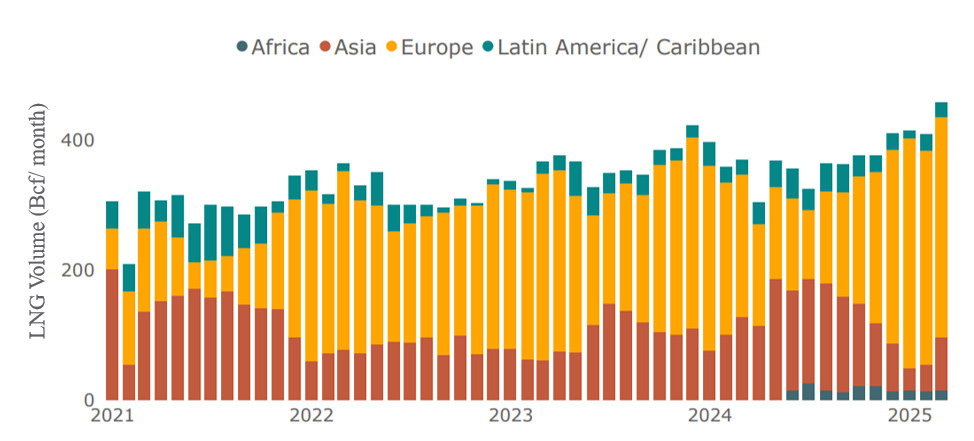
Despite ongoing tariff wars, U.S. LNG exports to Europe increased by 39% relative to the 738 Bcf recorded in the first quarter of 2024. Figure 2 highlights the growing proportion of European buyers within U.S. LNG export markets. Conversely, Asia observed a notable decline, with U.S. LNG exports in the first quarter of 2025 decreasing by approximately 48% compared to the same period in 2024, although there was a 29% increase relative to 2023. This reduction is largely attributed to the cessation of exports to China and a 62% fall in shipments to Japan, a principal U.S. LNG customer (DOE, 2025).
From early 2016 through March 2025, about 51% of U.S. LNG exports were directed to European nations (DOE, 2025). This rising dependence, coupled with the U.S. government’s realist policy stance, poses challenges for energy availability and accessibility in Europe. Nonetheless, Europe maintains hope that its political relationship with the U.S. will encourage a different approach from the American administration (Mišík, 2022). Following experience with diminished energy security due to reliance on Russian gas, European countries are actively seeking alternative sources (Casagrande & Dallago, 2015). Accelerating the transition to clean energy represents a potential solution for ensuring availability and accessibility; however, persistent trade disputes and ensuing economic recessions could hinder investment in clean energy and delay this transition (Voogt & Uyterlinde, 2006). The vulnerability of the European Union regarding energy availability and accessibility stems from a combination of factors, including geopolitical positioning, the U.S. government’s realist policies, and economic challenges should the tariff war persist.
China, the world’s largest LNG importer, sourced approximately 6% of its LNG from the U.S. in 2024 (Voogt & Uyterlinde, 2006). Following the escalation of the tariff war, U.S. shipments to China ceased entirely due to reciprocal tariffs and stricter trade controls, despite Chinese buyers maintaining numerous long-term contracts with U.S. suppliers (Reynolds, 2025). Should the dispute continue, contracted volumes may be redirected to Europe, potentially reducing short-term prices and diversifying EU supply routes, while a sustained global surplus may reduce LNG project returns. With the U.S. absent from the Chinese market, suppliers such as Australia, Qatar, Russia, and Malaysia have increased their shares, and China has expanded pipeline imports—primarily from Russia (Casagrande & Dallago, 2015).
The U.S. government’s realism-oriented policy leverages LNG as a geopolitical instrument, controlling and varying export volumes to assert its position as a supplier. Long-term LNG export contracts with China originally reflected an institutionalist strategy aimed at globalization, but China responded to recent U.S. policies by adopting a similar stance and discontinuing all U.S. LNG imports. Nevertheless, China continues to pursue institutionalist policies with other nations in the energy sector (Casagrande & Dallago, 2015).
B. Effects of the tariff war on energy affordability
The ongoing trade war has introduced considerable uncertainty into the market and heightened concerns regarding future economic growth. Nonetheless, energy and oil markets are shaped by a multitude of actors capable of adjusting supply to stabilize prices, thereby limiting the long-term impact of tariffs. These influences typically manifest as market shocks that are mitigated through the actions of other market participants (Reuters, 2025).
A notable effect of the tariff war on energy affordability is observed in shifts among suppliers. For example, Europe’s transition from Russian gas to U.S. LNG has resulted in elevated energy prices, causing excess costs estimated between 517 and 831 billion Euros from October 2021 to December 2022 (Federal Reserve Bank of Dallas, 2025). Altering energy suppliers generally leads to increased costs, as nations tend to procure commodities via the most economical channels. The trade war has necessitated a reassessment of energy supply routes, often requiring investment in new infrastructure (such as the Russian gas pipeline to China) or reducing affordability. As a result, affordability has been notably impacted on countries experiencing supplier route changes due to the tariff conflict.
C. Effects of the tariff war on energy acceptability
In China, persistent tensions between the U.S. and China are likely to pressure the post-COVID economy and sustain policies favoring low-cost energy for industrial recovery. This scenario weakens demand for domestic clean energy, limits subsidies, and accelerates consolidation among renewable energy firms. China’s institutional strategies highlight its capacity to leverage production power for profitable clean energy exports, though current priorities have shifted domestic supply toward local resources—particularly coal. Consequently, China’s clean energy industry is expanding its presence in the global market (Hove et al., 2021).
For the European Union, the ongoing U.S.–EU tariff conflict and related export-import restrictions have led to renewed emphasis on a realist approach in energy policy over institutional approaches. The EU now prioritizes affordable energy above the clean energy objectives set in the Paris Agreement. This shift results in reduced investment and subsidy allocation for clean energy and may promote a return to coal production and less environmentally compatible resources (Cheng et al., 2025).
In the U.S., newly imposed tariffs on clean-energy imports (175% on solar panels and 195% on wafers, cells, and polysilicon from China) increase production costs and strain supply chains for clean energy (Abrahams, 2025). Additionally, the combination of a 25% tariff on steel and aluminum with an extra 10% baseline tariff has substantially raised costs and project timelines for wind, solar, and transmission infrastructure. These materials are essential for turbines, substations, and transmission towers; collectively, these tariffs could escalate annual sectoral burdens from $400 million to approximately $53 billion, limiting investment and slowing progress toward renewable energy while affecting energy security (PwC, 2025). Coupled with executive actions supporting fossil fuels and imposing restrictions on wind projects, these measures heighten policy uncertainty, potentially deter investment, and may undermine the cost-competitiveness of clean energy relative to fossil fuels.
Table 1 summarizes the potential outcomes for China, the U.S., and the European Union, with starred items indicating results under the U.S.–EU tariff agreement, assuming such an agreement is plausible. Developing economies will also be influenced by the continuation of this conflict. These nations typically demonstrate lower willingness and risk tolerance for modifying existing energy flows and possess limited capability to employ energy as a geopolitical tool (Cantore et al., 2012). However, they remain receptive to adopting new options to address their energy security needs. For consumers, the possible negative consequences of the tariff war include price volatility and supply fluctuations arising from the controlling actions of energy suppliers operating within a realist framework.
D. What could the future hold for global energy security?
The U.S. led tariff war could impact global energy security in several ways. One possibility is that countries around the world may begin to focus more on their own or regional energy resources, investing heavily in self-reliance and lessening their dependence on international energy trade, which might be seen as risky. Alternatively, the tariff conflict could reinforce rival geopolitical blocs, each led by major powers. For example, China and its allies might speed up efforts to create a closed-off energy system, while the U.S. and its partners develop a separate approach—further fragmenting global energy markets. For the U.S. specifically, an intentional move towards energy security isolationism could occur. This would mean actively separating American energy infrastructure and supply chains from the rest of the world, striving for almost complete independence, even if it results in lower market efficiency and higher costs for energy at home.
IV. Conclusion
The Four A’s framework shows that the 2025 tariff war exposed global energy security to trade risks, disrupting supply chains and raising uncertainty over energy access—especially for LNG in the U.S., China, and EU. Price volatility increased but new market players helped stabilize prices. While reliance on cheaper fuels lowered costs, it also reduced incentives for renewables. Possible future scenarios include nations focusing on domestic energy, geopolitical blocs competing, or the U.S. separating its energy supply from global networks. Each scenario poses unique challenges for energy security.