
I. Introduction
Energy security has been a critical global issue since the 1970s oil crisis, and its scope has continued to expand in response to evolving global dynamics. A wide range of challenges contribute to energy security risks, including rapid changes in international relations, epidemics, globalization, terrorism and cyberterrorism, inequality in access to modern energy, natural disasters, and environmental degradation (Alehile et al., 2024; Khan et al., 2023; Singh et al., 2025). The rise of major energy consumers such as China, India, Russia, Brazil, and Iran has sparked renewed global discussions on energy security risks, making it essential to reassess the concept in light of these new challenges (Al-Saidi, 2023).
The most appropriate goal of energy security today is to ensure a stable, affordable, and sustainable energy supply. Achieving this requires increasing the use of renewable energy sources, which can help reduce market volatility, lower dependence on fossil fuels, and minimize environmental impacts (Bello & Ch’ng, 2024; Yang & Zhan, 2024). According to the Intergovernmental Panel on Climate Change (IPCC), a United Nations body for assessing the science related to climate change, the main goal in addressing climate change is to reduce greenhouse gas emissions and achieve net-zero targets in the long term. A critical step toward this is the transition from fossil fuels to renewable energy (Hansen et al., 2023). Feasibility studies further show that when social and environmental costs are considered, renewable energy can be competitive with even the cheapest fossil fuels (Kocak & Alnour, 2022).
Among renewable energy sources, wind energy stands out for its cost-effectiveness and sustainability. Research has well documented the multifaceted socioeconomic impacts of wind power, including economic growth, employment, regional development, energy demand, and social services (Brunner & Schwegman, 2022; Faturay et al., 2020). The hypothesis tested in this study is grounded in the theory of energy diversification, which posits that expanding the share of domestic renewables like wind power can reduce exposure to external supply shocks and price volatility—thereby enhancing energy security. However, no research has provided a statistical model for the long-term impact of wind power on energy security.
This paper examines the impact of wind energy on geopolitical and economic energy security in the United States. The U.S. provides a strong case study because it is the second-largest producer of wind energy, generating 425 terawatt-hours, which accounts for approximately 10 percent of its total electricity production (Wiatros-Motyka et al., 2024). Economically, a significant proportion of the U.S. economic product comes from energy, and energy price fluctuations directly affect all economic sectors as well as trade balances (EIA, 2024).
The contribution of this study is twofold. First, rather than relying on a general definition of energy security, we focus specifically on its geopolitical and economic dimensions, allowing for a more targeted assessment of wind energy’s strategic role. Second, to our knowledge, this is the first empirical study to statistically model the long-term impact of wind power on energy security in the U.S. context. This focus is particularly relevant given the growing concerns about the volatility, supply risks, and environmental consequences of fossil dependency. While other clean energy sources such as solar and hydro have also gained prominence, wind power stands out for its scalability and increasing cost competitiveness. Therefore, evaluating its long-term effects contributes to the broader debate on diversifying the U.S. energy mix in favor of sources that can enhance national security and environmental sustainability.
II. Methodology
To examine the impact of wind power on energy security, we employ a quadratic regression framework. This approach is well-suited for capturing non-linear relationships that are commonly observed in energy–economy dynamics. Prior research suggests that energy security risks may initially increase with rising income levels—due to higher energy demand—but later decline as countries adopt more efficient technologies and diversify their energy sources. Unlike simple linear models, the quadratic specification allows for such turning points and more accurately captures the complex interplay between economic development and energy vulnerability.
The regression equation was designed to model geopolitical and economic energy security risks based on natural and socio-economic factors, and a quadratic form was employed to assess the non-linear impact of wind power across these two dimensions.
GESRt=β0 +β1GDPt+β2GDP2t+β3CAPt+β4POPt+β5CO2t+β6WINDt+ϵt
EESRt=α0+α1GDPt+α2GDP2t+α3CAPt+α4POPt+α5CO2t+α6WINDt+θt
In Equations (1) and (2), the dependent variables are the Geopolitical Energy Security Risk (GESR) and Economic Energy Security Risk (EESR) indices, respectively. Higher index values indicate increased risk. The quadratic form is employed to capture the potentially non-linear relationship between income and energy security risk, as suggested by previous empirical studies, which indicate that energy risk may initially rise with economic activity but decline beyond a certain threshold due to efficiency improvements or policy interventions. The key explanatory variable is wind energy consumption (in trillion Btu). Control variables include GDP per capita (constant 2015 US$), gross fixed capital formation as a ratio to GDP (CAP), population (POP), and CO2 emissions (in million metric tons). Data on carbon emissions and wind energy consumption are sourced from the U.S. Chamber of Commerce’s Global Energy Institute and the U.S. Energy Information Administration (EIA), while macroeconomic indicators are sourced from the World Development Indicators (World Bank, 2025).

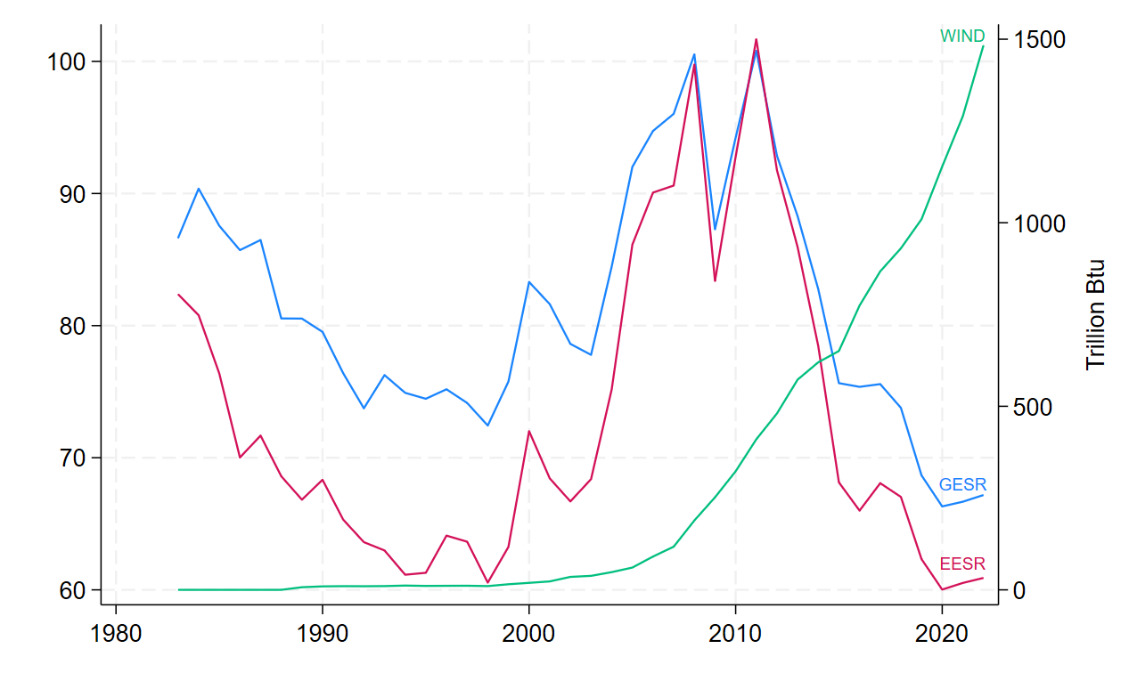
The sample period spans from 1983 to 2022, dictated by data availability. All variables are transformed into their natural logarithmic forms to facilitate elasticity interpretation and to address the right-skewed nature of variables such as GDP. Figure 1 plots the dynamics of the key variables of interest. As shown in Figure 1, wind power consumption started at negligible levels in the early 1980s, grew gradually until the mid-2000s, and then rose exponentially. Both the GESR and EESR indices experienced a notable decrease from the late 2000s onward, except for a brief increase during the 2007–2008 financial crisis. This overall decline coincides with the exponential rise in wind energy consumption.
The upper panel of Table 1 presents descriptive statistics and unit root tests. Aside from wind energy, all series follow a normal distribution. The unit root test results show that all variables exhibit unit roots at their levels but are stationary at their first differences.
In the bottom panel of Table 1, the correlation matrix summarizes the pairwise relationships among the study variables. Population is negatively correlated with GESR (-0.1465) but positively with EESR (0.1213), suggesting differing dynamics across the two dimensions, though the relationships are weak. GDP shows a similar pattern, with a negative correlation with GESR and a positive one with EESR. Wind energy consumption, the key variable of interest, is modestly negatively correlated with GESR (-0.1978), supporting its potential role in reducing geopolitical risk. These patterns provide preliminary insights and are examined in greater depth through the multivariate regression analysis that follows.
Estimating Equations (1–2) follows a two-stage strategy. First, the cointegration method developed by Maki (2012) is used. This test provides more robust results than conventional cointegration methods, as it considers the structural breaks that occur over time in the series. Secondly, the dynamic least squares (DOLS) method suggested by Stock and Watson (1993) is used for parameter estimation. For robustness, we also utilized fully modified least squares (FMOLS) and canonical correlation regression (CCR) estimators (Park, 1992; Phillips & Hansen, 1990).
III. Results
Table 2 shows the cointegration test results. The level shift with trend and regime shifts and trend statistics for Eq. (1) reject the null hypothesis of no cointegration. Similarly, regime shift and regime shifts and trend statistics for Eq. (2) also reject the null hypothesis of no cointegration. The results for both models confirm the existence of a long-run equilibrium among wind power, energy security risk, and control variables in the USA.
Table 3 reports on the parameter estimation results. According to the DOLS estimates for Eq. (1), wind energy has a mitigating effect on geopolitical energy security risk. FMOLS and CCR estimators also support this result. This implies that increasing the share of wind energy in the energy mix can reduce a country’s exposure to geopolitical threats, such as price shocks and supply disruptions. This finding is consistent with Cergibozan’s (2022) results, which show that renewable energy reduces energy security risk in OECD countries; Tugcu and Menegaki’s (2024) analysis for G7 countries; Aslam et al.'s (2024) findings for 41 BRI Belt and Road Initiative countries; and Wang and Tian’s (2025) evidence for 21 selected countries, among others. Furthermore, our results suggest a U-shaped relationship between GDP per capita and geopolitical energy security risk. Initially, economic growth reduces risk, but beyond a certain threshold ($39,735 to $45,026) risk begins to rise again. This indicates that while early-stage economic growth brings improvements in energy infrastructure and access, developed countries may face rising risks due to higher energy consumption and complexity in supply chains. Policymakers, therefore, should consider not just growth, but how energy systems evolve with increasing income. Additionally, physical capital, representing technological development, reduces geopolitical energy security risks, emphasizing the role of energy-efficient and clean technologies in building a secure energy future. CO2 emissions increase geopolitical energy security risk, reflecting the environmental vulnerabilities associated with fossil fuels. Population has no significant effect, suggesting that energy risk is driven more by energy systems and structures than by population size.
All estimators for Eq. (2) consistently show that wind energy reduces economic-based energy security risk, thereby reinforcing the findings of Eq. (1). This suggests that wind energy helps stabilize market prices and decreases the economy’s vulnerability to energy price shocks, ultimately promoting macroeconomic stability. The U-shaped relationship between GDP and economic-based energy security risk is again observed, with the turning point occurring between $42,616 and $49,020. This pattern supports the notion that initial stages of economic development enhance energy access and affordability, while more advanced economies may face increasing risks due to heightened demand pressures. Additionally, the analysis reveals that CO2 emissions raise economic-based energy security risk, whereas physical capital reduces it, underscoring the importance of investing in clean energy technologies. Population remains statistically insignificant in affecting economic-based energy security risk.
Overall, these findings show that wind energy strengthens energy security by reducing both geopolitical and economic vulnerabilities. In practice, this suggests that expanding wind power capacity not only contributes to decarbonization but also enhances national energy resilience, supporting both environmental and energy policy goals.
IV. Conclusion
This study reframes the concept of energy security by demonstrating that renewables—particularly wind energy—are not just environmentally beneficial but also strategically vital. To examine this evolving role, we modeled the long-term impact of wind power on geopolitical and economic energy security in the United States. Using robust estimation strategies, our findings confirm a significant mitigating impact of wind energy on energy security risk. These results support policy initiatives aimed at scaling up wind energy as part of a broader national security and economic strategy.
Importantly, the evidence highlights a paradigm shift: wind energy is not only a tool for environmental sustainability but also a key instrument in reducing geopolitical risks. This shift moves beyond traditional notions of energy security, revealing the capacity of renewables to stabilize not only energy markets but also political landscapes. The strong inverse relationship between wind energy consumption and threats to secure energy supply emphasizes the untapped potential of renewables to reduce dependence on politically unstable regions for energy supply—a particularly significant insight in the context of global energy geopolitics.
Acknowledgment
We thank the Editor, Afees Salisu, and the two anonymous reviewers for their constructive feedback and insightful comments, which have significantly enhanced the quality of this manuscript.