
I. Introduction
In recent years, research has increasingly highlighted the significance of behavioural factors in shaping economic outcomes. One such factor gaining attention is language (Ginsburgh & Weber, 2020). Specifically, Future Time Reference (FTR) refers to how languages distinguish between the present and the future. In strong-FTR languages, there is a clear, explicit separation between present and future events, whereas weak-FTR languages do not make this distinction as sharply. According to Chen (2013), speakers of strong-FTR languages are generally less likely to engage in future-oriented economic and social behaviours—such as saving more or smoking less—compared to speakers of weak-FTR languages.
However, the relationship between FTR and energy consumption has not been thoroughly examined. Previous studies have explored the influence of microeconomic (Bhattacharyya & Timilsina, 2009; Suganthi & Samuel, 2012) and macroeconomic factors (Dokas et al., 2022; Wang et al., 2019) on energy consumption, but have largely overlooked the role of behavioural considerations, particularly language.
Language can influence energy use in two principal ways (Roberts et al., 2015). First, the distance hypothesis suggests that speakers of strong-FTR languages perceive the future as more distant, making them less likely to engage in forward-thinking behaviour such as reducing fossil fuel use and increasing adoption of renewable energy. Second, the precision hypothesis posits that these speakers may view the present and future as substantially separated, leading to a higher discounting of future outcomes and, as a result, less prudent decision-making. In both cases, it appears that countries with strong-FTR languages may be less inclined to transition toward renewable energy sources. This negative impact of strong-FTR on financial and real outcomes is consistent with recent research in various fields, including banking (Osei-Tutu & Weill, 2021), corporate finance (Guan et al., 2022), entrepreneurship (Hechavarria et al., 2023), and environmental policy (Mavisakalyan et al., 2018).
This forms the central hypothesis of the paper. Specifically, using cross-national data from 2001 to 2022, we assess whether strong-FTR languages affect energy consumption patterns. The dependent variables, measured in kilowatt-hours per person, include total primary energy consumption and its components, such as fossil fuels (coal, oil, and gas) and renewables (solar, wind, and hydro). We analyse the relationship between strong-FTR languages and energy consumption across both Advanced and Emerging Market and Developing Economies (EMDEs), while controlling for economic, social, cultural, institutional, religious, and legal factors to isolate the effect of language.
The remainder of the paper is structured as follows: Section II describes the data and variables, Section III presents the results, and Section IV concludes.
II. Data
The data includes country-level variables. The dependent variables (mentioned earlier) are obtained from the Statistical Review of World Energy, published by the Energy Institute. This review provides a comprehensive assessment of the global energy system and the transition pathways in response to evolving economic and policy developments.
The cross-country information on the FTR of languages is taken from Chen (2013), which also provides the Verb Ratio (VR) and Sentence Ratio (SR) of FTR languages (see Table 1, Panel A for details). The final list comprises countries where the official language is classified as either strong- or weak-FTR (Chen, 2013). Countries with multiple FTR languages are excluded from the analysis due to the lack of consistent time-series data on the proportion of the population speaking these languages (e.g., Campo et al., 2024; Kong et al., 2022). After applying these adjustments, the final sample consists of 92 countries (including 61 EMDEs); 77 countries speak a strong-FTR language. On average, there are 21.5 years of observation per country, resulting in a maximum of 1,978 country-years.
The country-level controls include variables related to education (proxied by adult literacy rate, obtained from the Barro-Lee website), cultural dimensions such as uncertainty avoidance and long-term orientation (from the Hofstede website), institutional variables including the Kaufmann index of governance (from the World Bank website), and legal origin (from the La Porta website). For example, inadequate governance may hinder the uptake of renewable energy sources due to uncertain economic opportunities, limited access to finance, and other formal and informal barriers. Legal origins also matter, as common law countries may be less inclined to invest in renewables, owing to greater constraints on their development (Liu et al., 2021). The relevance of religious beliefs for energy consumption has also been documented in recent research (Leslie et al., 2022).
Other variables included in the analysis are macroeconomic and social factors (e.g., per capita income, inflation, population and real GDP growth), as well as financial controls (e.g., credit-to-GDP ratio, all obtained from the World Bank), and religious variables (which equal one if the dominant population of a country is Christian, Muslim, or Other, and are obtained from Pew Research). Higher income per capita may provide greater flexibility to shift toward renewable energy sources. A more educated population may be better aware of the harmful effects of fossil fuels, making them more receptive to renewables. Likewise, financial development helps lower financing costs and fosters an environment conducive to adopting clean energy by facilitating access to finance when it is most needed.
Before conducting the empirical analysis, a quick glance at the sign and significance of the bivariate correlations (Table 1, Panel B) suggests that strong-FTR lowers total energy consumption, including both renewable and non-renewable components.
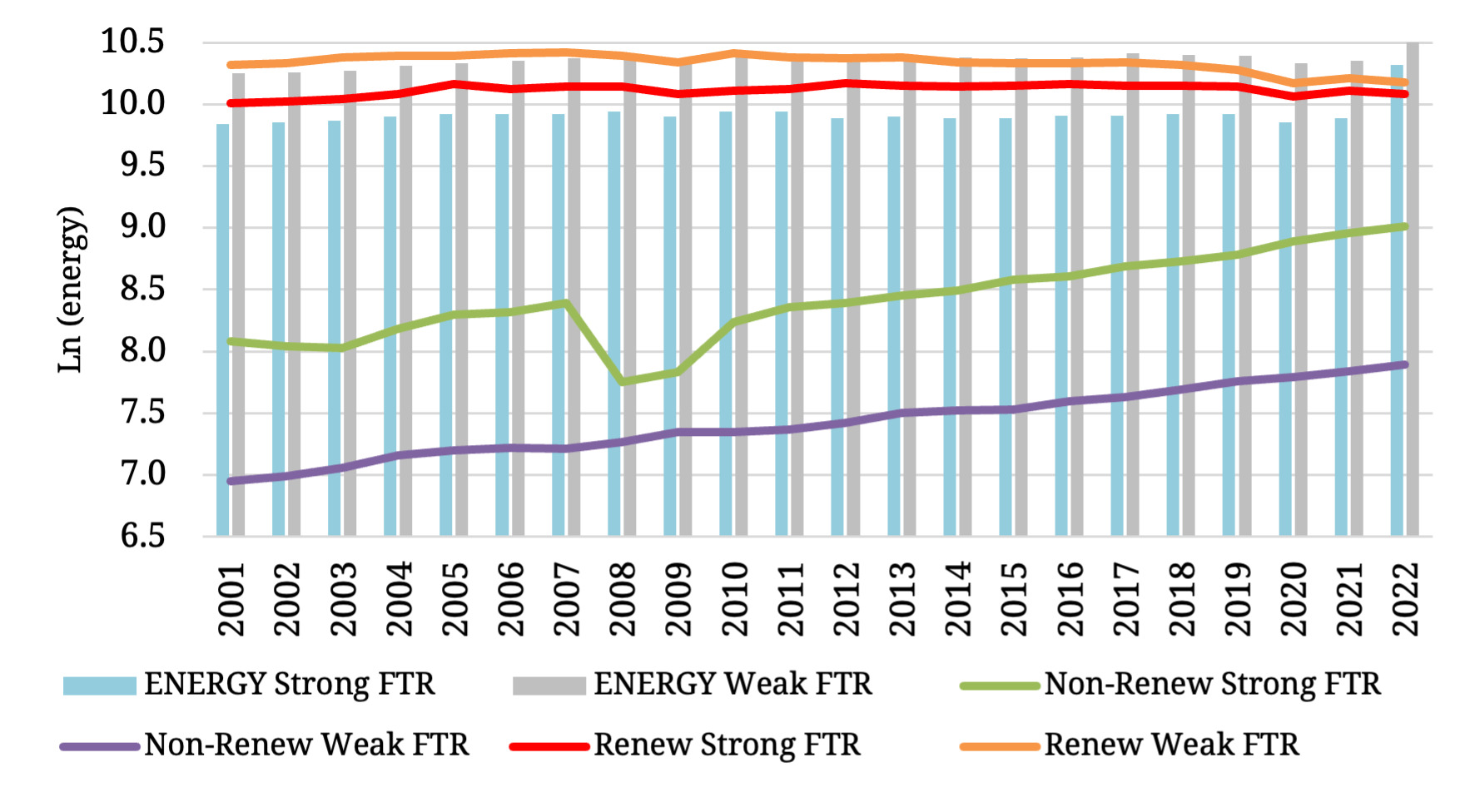
Figure 1 presents the average values of energy consumption (total, as well as renewables and non-renewables) categorised by weak- and strong-FTR countries. The figure shows that although overall energy use is, on average, higher in weak-FTR countries, their renewable energy consumption also surpasses that of their strong-FTR counterparts, consistent with the latter’s weaker forward-looking orientation.

III. Methodology and Main Findings
A. Methodology
To investigate the impact of strong-FTR on energy consumption we estimate the following regression model:
ykt=α+μ(Strong FTRk∗Advancedk)+β Strong FTRk+γ Advancedk+Mktθ′+εkt
where y denotes the (natural logarithm of) various measures of energy consumption and are country-specific controls; ε is random error. The overall impact of on energy consumption is where is the average impact and is the impact via advanced economies (Advanced). Following our previous discussion, it appears likely that in the case of fossil fuel and its disaggregated components and likewise, in the case of renewable energy and its components. Additionally, provided advanced economies behave in a similar fashion, would be negative in the case of renewable energy and its components.
We employ a random effect (as opposed to the fixed effects, FE) specification for two reasons. First, the strong-FTR variable is invariant over time and across countries; the impact of this variable would get absorbed in the FE specification. This is a key limitation of the variable, since treating FTR as static might introduce classification bias, especially in multilingual societies, such as Nigeria and Switzerland. Second, since the cross-sectional dimension (92 countries) far exceeds the time dimension (22 years), FE estimation might provide imprecise estimates.
B. Main Findings
Table 2 presents the main findings. In strong-FTR countries, non-renewable energy consumption rises (column 2), although there is no clear effect on renewable energy use (column 6). Based on the point estimate from column 2, non-renewable consumption increases by 64%. This positive coefficient for strong-FTR is in line with previous expectations. However, the negative coefficient on the interaction term in column 6 suggests that advanced economies with strong-FTR have increased their renewable energy use by 65% (column 6), likely reflecting an appreciation for its benefits.
When examining specific components of non-renewables, strong-FTR countries demonstrate increased oil consumption (column 4). In contrast, advanced economies appear to be reducing oil use, resulting in only a marginal net increase of 3% (=0.59–0.56). For renewables, advanced economies with strong-FTR are increasing their consumption of solar (column 7) and hydropower (column 9). Interestingly, in the case of solar energy, strong-FTR countries as a whole tend to lower their consumption.
To ensure robustness, we also employ the VR and SR which are continuous variables, unlike the binary nature of strong-FTR. Results from Table 3, focusing on major components, show a statistically significant decline in overall energy consumption for both variables (columns 1 and 4). However, advanced economies, despite their strong future-oriented language, are increasing energy consumption primarily by boosting their use of renewables. According to the point estimates in columns 3 and 6, a one standard deviation increase in either VR or SR leads to a 0.8 percentage-point rise in energy consumption (about 10% relative to the sample mean). These results indicate that advanced economies are beginning to show more prudent behaviour in their energy use, even with a strong-FTR language orientation.
IV. Concluding remarks
The analysis underscores the influence of strong-FTR language orientation on the consumption of both renewable and non-renewable energy sources. Notably, the main finding reveals that advanced countries are now demonstrating greater prudence in their consumption patterns by prioritizing renewables, even in the context of a strong FTR orientation.
Two key policy implications emerge from these results. First, language should be recognized as a factor that shapes energy consumption and should be accounted for in future policy development. More broadly, the findings point to the potential benefits of “behaviorally informed energy policy,” a theme that has so far received limited attention in energy research. Second, it is important to raise awareness in emerging and developing economies (EMDEs) about the negative impacts associated with increased reliance on non-renewables.
As climate concerns become ever more prominent, the need for a balanced energy mix is gaining increased attention. Integrating the language dimension into this discussion will be crucial for countries seeking to move towards more sustainable energy pathways.
CRediT
Saibal Ghosh: Conceptualization, Data curation, Original draft and validation